

The AI operating system needs a memory layer
McKinsey has given a useful name to a problem many CEOs already feel.
Companies are adopting AI quickly, but the financial results are lagging. In its October 2026 paper, The AI operating system: A new way for CEOs to run the enterprise, McKinsey reports that 40% of respondents at large companies are scaling AI agents, while only 6% attribute at least 5% of EBITDA to AI.
That gap is not mainly a model problem. It is a context problem.
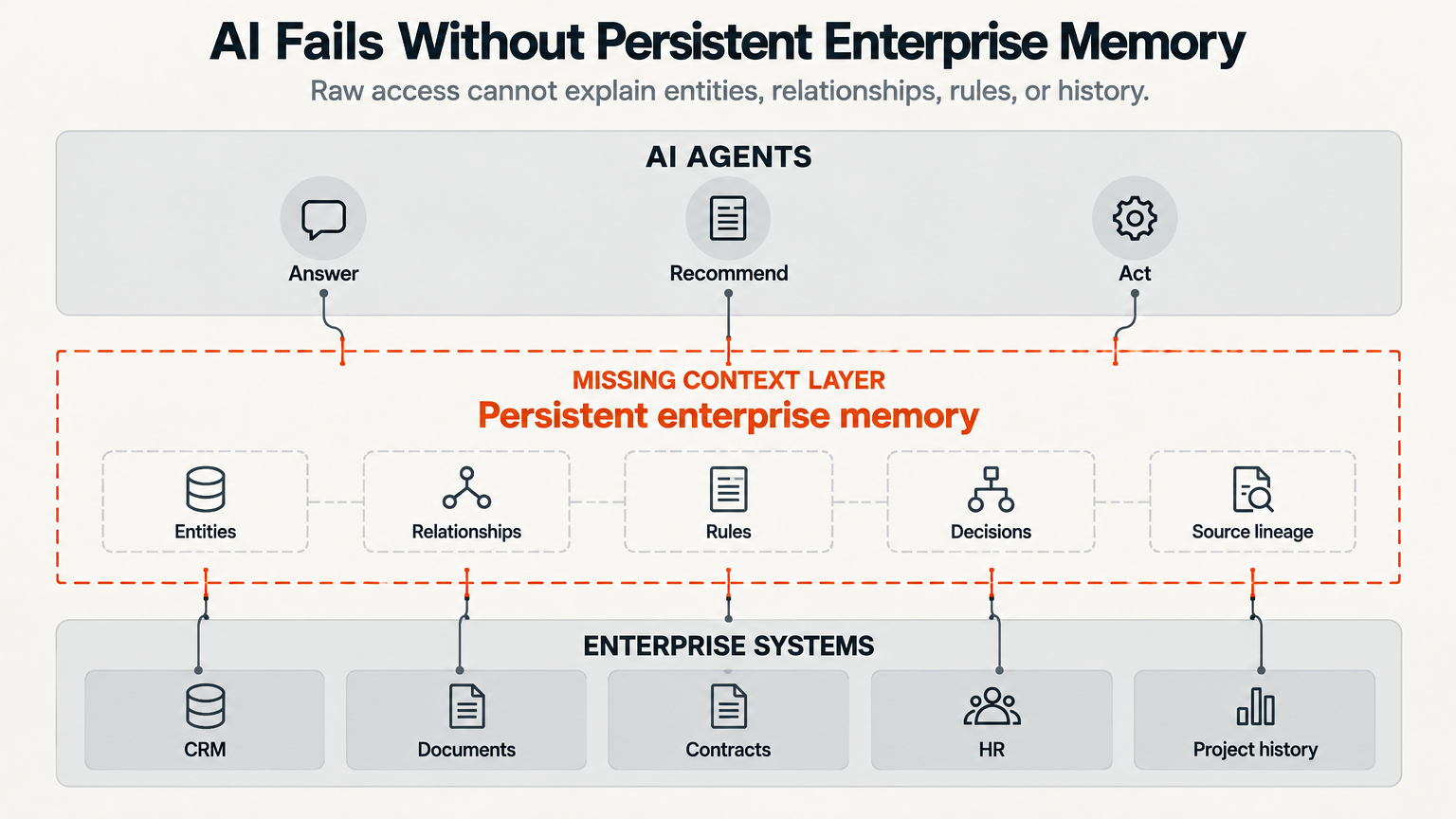
An agent can draft an email, summarize a document, or answer a narrow question. But to help run a business, it needs to understand how the business works: its clients, people, projects, contracts, policies, decisions, risks, and the relationships among them. Most of that knowledge is scattered across systems or still lives in employees' heads.
McKinsey calls the answer an AI operating system: a continuously operating management layer that maintains enterprise context, reasons across functions, recommends or executes decisions, and learns from outcomes. The paper describes it as the enterprise's "second brain."
That is the right ambition. The part CEOs should not miss is what makes the second brain possible.
The semantic layer is the foundation
The paper places a semantic layer at the center of the AI operating system. It gives AI a consistent understanding of the enterprise: entities, relationships, definitions, policies, and business logic. McKinsey specifically identifies ontologies and knowledge graphs as ways to make this context explicit, persistent, and reusable.
This matters because raw access is not the same as understanding.
Connecting an LLM to SharePoint, a CRM, an ERP, email, and contract repositories does not automatically create institutional intelligence. The agent still needs to know that a person mentioned in a proposal is the same expert listed under a different title in the CRM; that a contract clause affects a current project; or that a past-performance example satisfies the requirements of a new opportunity.
A knowledge graph gives those relationships structure. An ontology gives them meaning. Together, they let agents work with the relevant slice of enterprise knowledge instead of searching every document from scratch.
"Own the context; rent the technology"
The sharpest line in McKinsey's paper is also the most important strategic principle: "Own the context; rent or replace the technology."
Models will keep changing. Today's best model will not stay the best model. Companies that bury their institutional knowledge inside one vendor's application risk rebuilding their intelligence layer every time the technology shifts.
The durable asset is the company's context: its accumulated expertise, operating history, business rules, and decisions. That intelligence should remain portable across models and systems.
This is especially important for professional-services firms. Their advantage is rarely a physical asset. It is the collective memory of what the firm knows, who knows it, what worked before, and how to apply that experience to the next client problem. When that knowledge is fragmented, the firm loses time, repeats work, and watches expertise leave when people do.
Start with a valuable decision, not a data migration
Another useful point in the paper is that an AI operating system does not require a multiyear data overhaul before it can create value. McKinsey recommends leaving data in existing systems, building relationships across it, and improving source data as the work produces value.
That changes the starting question.
Instead of asking, "How do we centralize all our data?" leaders can ask:
- Which decisions are slowed by fragmented knowledge?
- Which workflows depend on a few people knowing where everything is?
- Where are teams recreating proposals, deliverables, or analysis that already exists?
- Which business rules should agents understand before they can act safely?
For a government contractor, the first domain might be matching past performance and key personnel to an opportunity. For a consulting firm, it might be finding reusable expertise across proposals and client work. For an accounting or engineering firm, it could be connecting obligations, project experience, and specialist knowledge across systems.
Each use case adds reusable context to the same intelligence layer. That is how the investment compounds.
The second brain changes management, too
McKinsey's thesis goes beyond technology. If enterprise context is continuously available, management no longer has to revolve around periodic meetings that exist mainly to gather information and report status.
Leaders can manage by exception instead of by calendar. They can intervene when a threshold is crossed, test a scenario while a decision is still live, and spend more time applying judgment rather than moving information through layers of the organization.
That future will not arrive by giving every department another copilot. It requires shared context, explicit decision rights, traceable sources, and guardrails that determine what agents may recommend, execute, or escalate.
From scattered knowledge to an operating system
At Experio, this is the problem we are building IQ1™ to solve for professional-services firms.
IQ1™ creates an ontology-based knowledge graph across the systems firms already use. It connects clients, experts, contracts, proposals, projects, and past performance so people and agents can retrieve source-traceable answers and reuse institutional knowledge in real workflows.
McKinsey's paper expands the frame across the enterprise. We agree with its central conclusion: the companies that win will be those that turn accumulated knowledge into a living, reusable intelligence layer.
The model is not the moat. The enterprise memory behind it is.
Source: McKinsey & Company, The AI operating system: A new way for CEOs to run the enterprise, Asutosh Padhi, Brian Elliott, Daniel Swan, Kim Baroudy, and Vik Sohoni, October 2026.