

The $31.5 Billion Knowledge Problem Hiding in Plain Sight

I've spent three decades watching expertise walk out the door.
Senior partners retire. Teams get reorganized. Acquisitions shuffle the deck. And every single time, something irreplaceable vanishes—the institutional knowledge that made those people valuable in the first place.
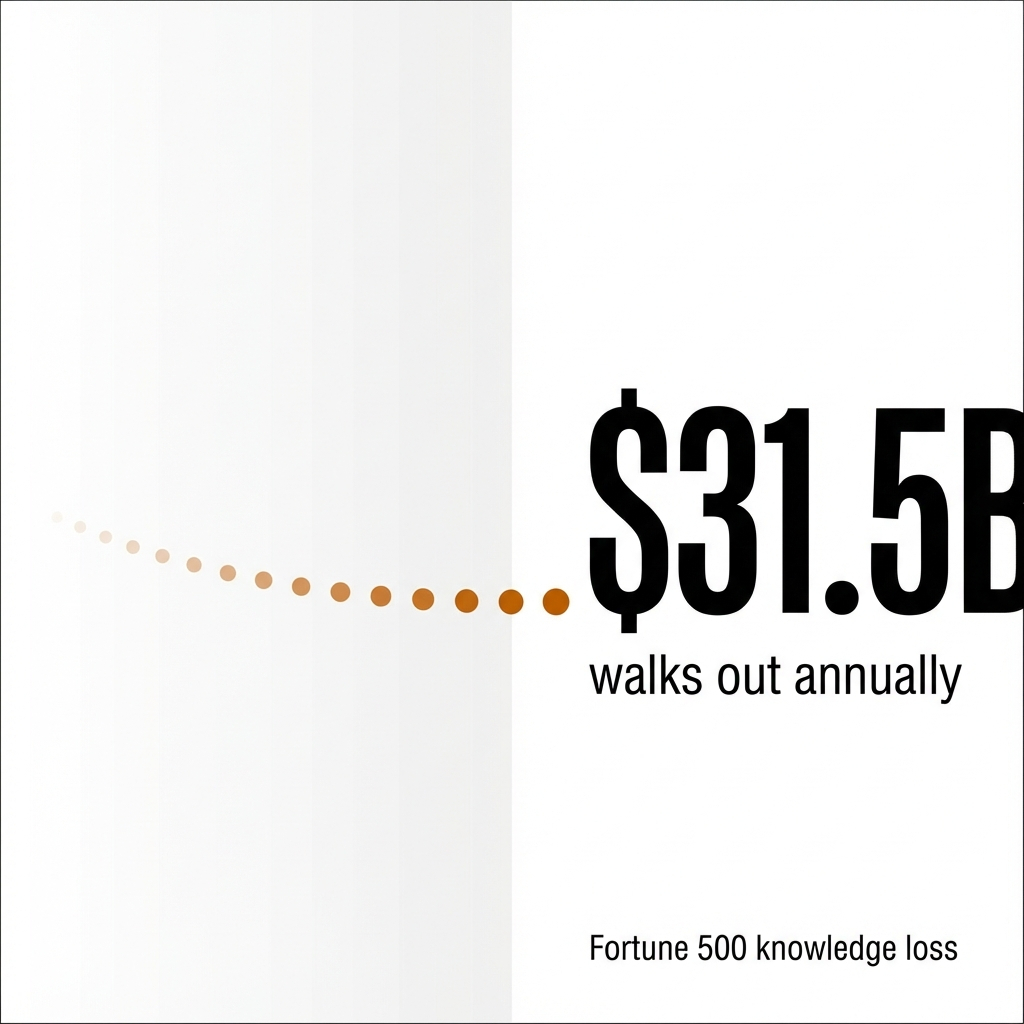
Here's what surprised me: Fortune 500 companies lose at least $31.5 billion yearly by failing to share knowledge effectively. That's not a soft HR problem. That's a structural liability with a dollar amount attached.
The consulting industry treats this as normal. I stopped accepting that years ago.
The Hidden Tax on Every Billable Hour
Your knowledge workers spend 20-25% of their work week searching for information they need to do their work. That's 8-10 hours per week. One full day vanishing into the gap between what your firm knows collectively and what any individual can access.
I see this play out in three specific ways:
The recreation tax. Someone builds a solution for a client. Six months later, a different team faces the same problem and starts from scratch because they don't know the first solution exists.
The expertise bottleneck. Your best people become internal search engines. They spend hours each week answering questions they've already answered because there's no system that remembers what they said.
The departure drain. When seasoned employees leave, they take tacit knowledge that isn't documented anywhere. The cost of replacing one employee ranges from one half to two times their annual salary—but the knowledge loss creates operational inefficiencies that compound for years.
You're not just losing productivity. You're losing the accumulated intelligence that makes your firm valuable.
Why Silos Persist Despite Universal Recognition
Here's the disconnect that fascinates me: 83% of executives believe their companies have silos and 97% say siloed data has harmed their business.
The recognition is near-universal. The solution remains elusive.
Most leaders treat silos as a cultural problem. They launch knowledge-sharing initiatives. They create collaboration platforms. They encourage documentation.
The silos persist because the diagnosis is wrong.
This isn't a people problem. It's an infrastructure problem. You can't culture your way out of a structural flaw in how knowledge moves through your organization.
65% of respondents say remote and hybrid working has made collaboration more complex. The shift to distributed work didn't democratize knowledge—it amplified the cost of fragmentation.
When your team worked in the same office, informal knowledge transfer happened accidentally. Someone overheard a conversation. A quick hallway chat solved a problem. Proximity compensated for poor systems.
That compensation mechanism is gone. The infrastructure gap is now visible.
What Organizational Consciousness Actually Means
I don't use that term lightly. Most people hear "organizational consciousness" and think I'm talking about culture or values.
I'm talking about memory as infrastructure.
A conscious organization knows what it knows. It can access its collective intelligence without depending on who happens to be in the room. It learns from experience instead of repeating the same mistakes with different teams.
The technical architecture matters here. You need a system that doesn't just store information—it understands context. It recognizes when a current question maps to past experience. It surfaces relevant expertise before someone wastes a day searching.
Organizations with intensive knowledge management processes are more competitive than their counterparts. That's not correlation. That's cause and effect. Your competitive advantage depends on how effectively you deploy what your people already know.
The ROI of Treating Memory as Infrastructure
The financial case is straightforward: Businesses achieve an ROI of up to 400% by investing in knowledge management solutions.
Here's how that math works in practice:
Reduced search time. When knowledge workers spend 30% of their day searching for information, even a 50% reduction in search time returns 15% of total capacity. That's billable hours appearing without adding headcount.
Accelerated onboarding. New hires become productive faster when they can access institutional knowledge directly instead of waiting for someone to teach them. The average enterprise loses $4.5 million annually in productivity from failing to preserve and share knowledge.
Reusable expertise. When you solve a problem once and capture that solution properly, every subsequent team benefits. The marginal cost of deploying that knowledge approaches zero.
Retained competitive advantage. Your differentiation doesn't walk out the door when people leave. The knowledge that made them valuable stays accessible to the organization.
Building Systems That Remember
I've built three companies by recognizing what gets lost in translation and engineering precision where others tolerate approximation.
The pattern is consistent: identify the structural waste, then build infrastructure that eliminates it.
At Experio, we're encoding institutional memory into an AI operating system that understands context. Not a chatbot. Not a search tool. An infrastructure layer that makes collective intelligence accessible.
81% of organizations report that data silos are hindering digital transformation efforts. You can't transform what you can't access. The strategic initiatives consulting firms need to remain competitive get blocked by fragmented knowledge.
The firms that solve this early get an advantage. The firms that wait get disruption.
What This Means for Your Firm
You already recognize the problem. The data confirms you're not alone—60% of participants in recent surveys said it was difficult or almost impossible to get essential information from their colleagues.
The question isn't whether knowledge silos harm your business. The question is whether you're treating memory as infrastructure or accepting expertise loss as inevitable.
Every day you wait, more knowledge walks out the door. More hours vanish into search. More teams recreate solutions that already exist somewhere in your organization.
The technology to solve this exists now. The business case is proven. The competitive advantage goes to whoever moves first.
I'm not building software. I'm installing organizational memory where none existed—and redefining what intelligence means when it's collective, continuous, and accessible.
Your firm already has the expertise. You just need the infrastructure to remember it.