

Stop Buying AI Tools. Start Fixing Workflows.

I've watched dozens of professional services firms launch AI initiatives over the past two years.
Most of them follow the same pattern.
They start by asking: "What AI tool should we deploy?" or "Which license should we buy?" or "What pilot can we launch quickly?"
Then they wonder why adoption stalls at 12% and the ROI never materializes.
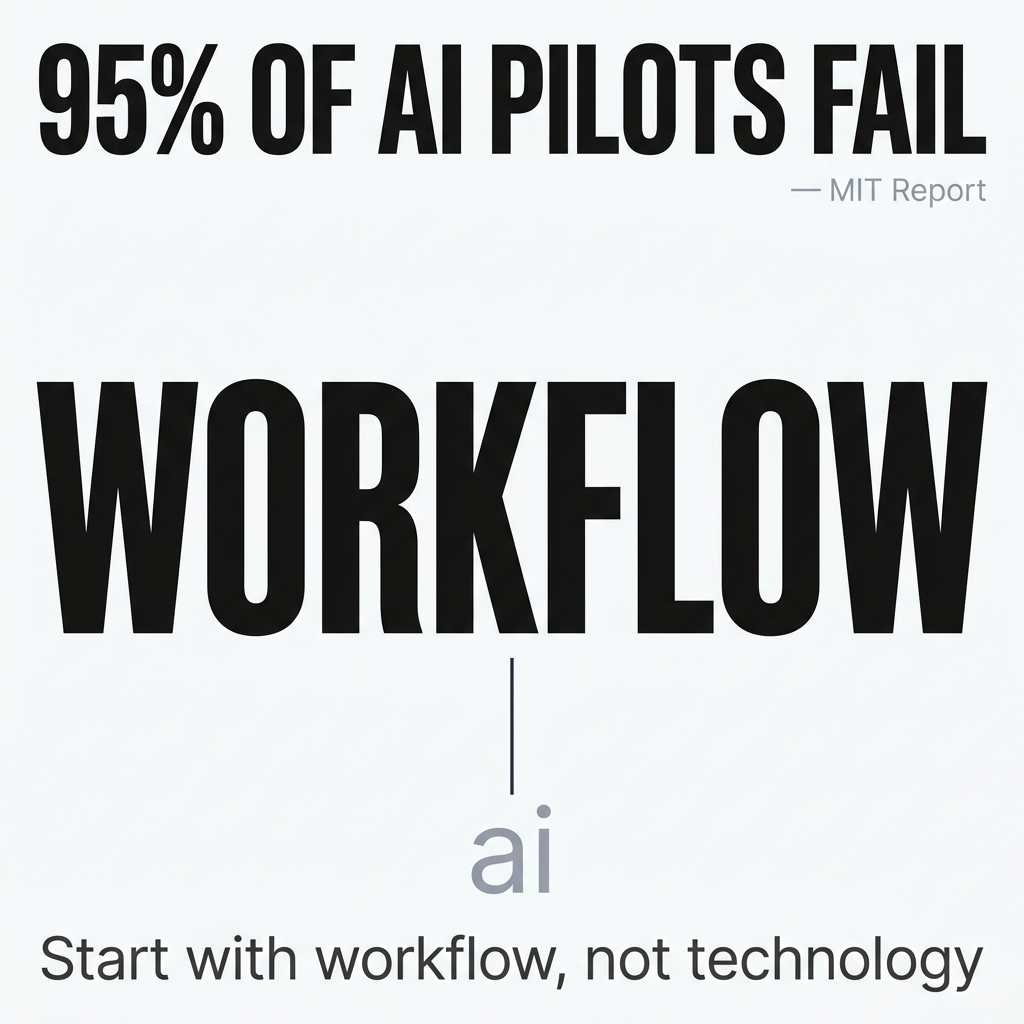
The problem isn't the technology. 95% of AI pilot programs fail to deliver measurable impact on profit and loss, according to MIT's 2025 GenAI Divide report. That's not a model problem. That's a strategy problem.
The Real Problem Isn't Intelligence
In most organizations, the bottleneck isn't a lack of smart people or powerful models.
It's a lack of usable context.
Information lives in email threads, meeting notes, Slack channels, CRM fields, project folders, SharePoint sites, and inside people's heads. When someone needs to make a decision, write a proposal, or onboard a new client, they spend hours reconstructing context that should already be accessible.
Employees waste 1.8 hours every day searching for information. That's nearly a quarter of their workweek spent on digital scavenger hunts.
For consulting firms, the math gets worse. 30% of billable time vanishes into searching, asking, and recreating work that someone else already did. That's not a productivity issue. That's a structural failure.
When you add another AI tool on top of this fragmented system, you don't reduce friction. You create another destination people have to remember, learn, and maintain.
Why Most AI Deployments Disappoint
The companies seeing real value from AI aren't starting with the model.
They're starting with the workflow.
Organizations reporting significant financial returns from AI are twice as likely to have redesigned end-to-end workflows before selecting modeling techniques, according to McKinsey's 2025 AI survey.
That's the inversion most leaders miss.
They treat AI as a feature to bolt on. The firms that win treat it as a workflow redesign opportunity.
Where AI Actually Adds Value
AI becomes useful when it removes friction at the exact moment work gets stuck.
Here are three places where that happens consistently:
Meeting Follow-Up
After a client call or internal strategy session, the work immediately splinters.
Notes go into one system. Action items get added to another. CRM updates happen later (or not at all). Follow-up emails sit in drafts. Someone has to manually reconstruct what was decided and who owns what.
AI can close that gap automatically. It can turn conversation into structured next actions, update the systems that matter, and draft the follow-up communication while the context is still fresh.
The value isn't transcription. It's eliminating the reconstruction work that happens after every meeting.
Account and Client Research
Before a meeting, teams manually piece together context from past emails, CRM history, project notes, and scattered web research.
This prep work can take 60 minutes to days, depending on the complexity of the relationship and how fragmented the information is.
AI can compress that time dramatically, but only if it's connected to the actual systems where context already lives. A standalone tool that requires manual uploads doesn't solve the problem. It just moves the friction to a different step.
Internal Knowledge Retrieval
People ask versions of the same question dozens of times a week:
"Have we done this before?"
"Where is that deck?"
"What did we decide?"
"What's the latest version?"
These questions shouldn't require Slack threads, email searches, and asking three different people. AI becomes valuable when it helps teams retrieve operational truth quickly, without digging through five tools and three message threads.
The goal isn't to build a better search bar. The goal is to surface the right answer at the moment someone needs it, embedded in the workflow they're already in.
The Shift Leaders Need to Make
Stop treating AI as a feature rollout.
Start treating it as a workflow redesign opportunity.
The question isn't "How do we use AI more?" The question is "Where does work break down because context is missing?"
Before launching the next AI initiative, ask:
Where does work break down today?
Identify the specific moments where decisions stall, proposals take too long, or people recreate work that already exists.
Where are decisions delayed because context is missing?
Look for the places where smart people spend time hunting for information instead of making decisions.
Where are people doing low-value reconstruction work?
Find the tasks where expertise gets wasted on reassembling context, summarizing meetings, or tracking down the latest version of something.
Where could AI remove friction without adding complexity?
Focus on the workflows where AI can operate invisibly, reducing steps rather than adding new tools to learn.
What Success Actually Looks Like
AI at work doesn't win when it looks impressive in a demo.
It wins when it quietly makes the organization run better.
The firms that get this right don't measure success by adoption rates or feature usage. They measure it by time saved, decisions accelerated, and expertise preserved.
They don't ask "How many people logged into the AI tool this week?"
They ask "How much faster did we close that proposal?" and "How quickly did the new hire get up to speed?"
The difference matters.
One approach treats AI as a product to deploy. The other treats it as infrastructure that makes everything else work better.
The Path Forward
If you're leading AI strategy at a consulting firm, the next 12 months will separate the firms that installed tools from the firms that redesigned workflows.
The ones that win won't have the fanciest models or the biggest AI budgets.
They'll be the ones that identified where work actually breaks down and built AI into those exact moments.
They'll be the ones where institutional memory becomes infrastructure instead of folklore.
They'll be the ones where new hires get productive in days instead of months.
They'll be the ones where 30% of billable time stops vanishing into information scavenger hunts.
The technology is ready. The question is whether your workflows are.