

Why Your AI Still Hallucinates: The EMNLP 2025 Research That Explains Everything

I've spent three decades watching consulting firms lose what makes them valuable.
The expertise walks out the door. The institutional memory evaporates. The hard-won insights from thousands of client engagements scatter across systems that can't talk to each other.
So when AI promised to solve this, I paid attention. RAG systems. Vector databases. Context windows that could swallow entire libraries. The technology looked promising.
But the EMNLP 2025 research confirmed what I'd been seeing in practice: even the most advanced LLMs with RAG are fundamentally insufficient for complex reasoning.
The problem isn't the AI. It's the architecture underneath.
The Retrieval Trap
Standard RAG systems retrieve documents and hope the LLM figures out the connections. EMNLP research shows this approach "can lead to inefficiencies" because single retrieval followed by generation collapses when you need multi-step reasoning.
Think about how consulting actually works.
A client asks about regulatory compliance for a new market entry. You need to connect:
- Previous work in that jurisdiction
- Similar client situations across different industries
- Regulatory changes from the past 18 months
- Internal expertise from three different practice areas
- Compliance requirements that interact with each other
That's not document retrieval. That's relationship traversal.
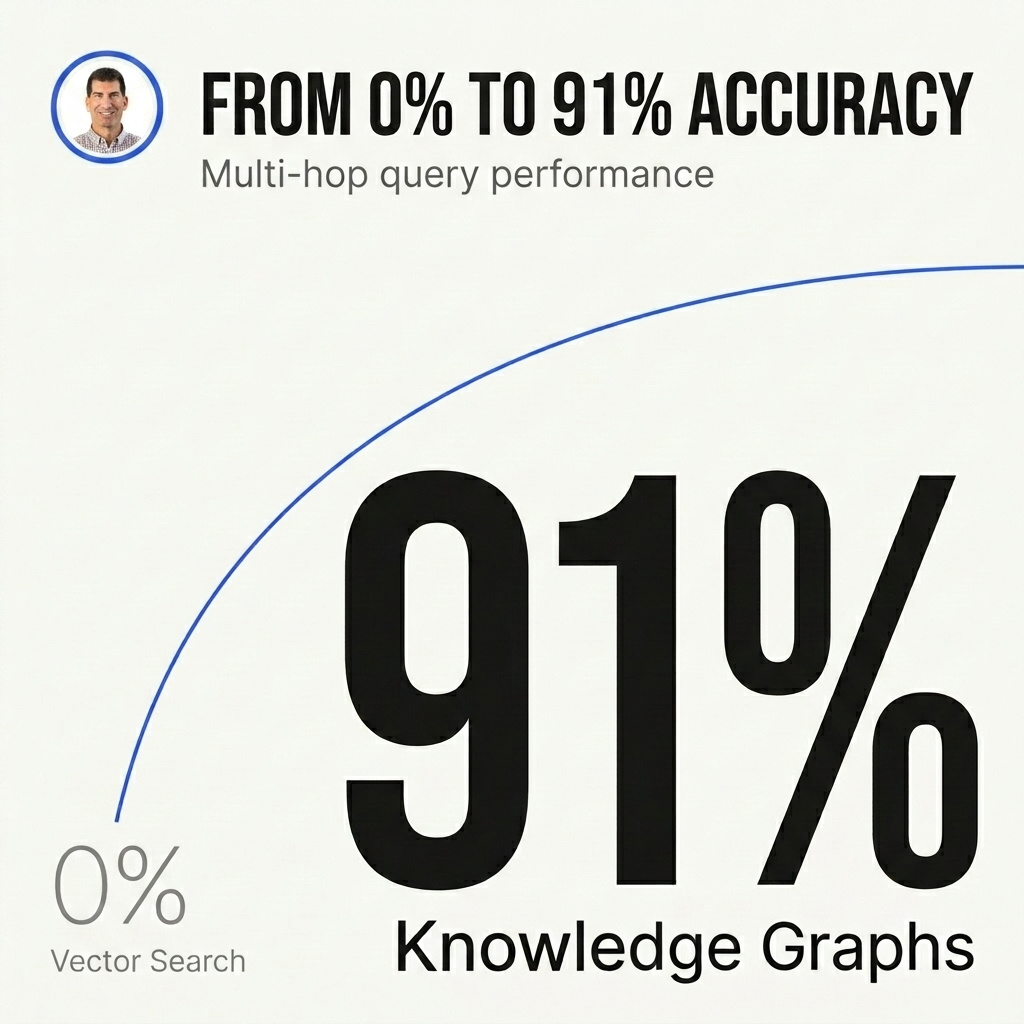
And this is where vector search breaks down completely. FalkorDB's 2025 benchmark showed vector search accuracy drops to 0% when queries involve more than five entities.
Zero percent.
For consulting firms where a single question routinely touches multiple projects, clients, methodologies, and stakeholder relationships simultaneously, this represents a catastrophic failure mode.
The Context Problem Nobody Talks About
Vector databases find similar documents. Knowledge graphs understand relationships.
The difference matters more than most people realize.
When you search by similarity, you get documents that look related. When you traverse relationships, you get documents that are related through explicit connections your organization has already validated.
Research from three enterprise case studies identified seven specific failure points when engineering RAG systems. The core issue: "RAG systems suffer from limitations inherent to information retrieval systems and from reliance on LLMs."
Translation: retrieving context is not the same as understanding context.
I saw this firsthand when we were building Experio. Early prototypes used vector embeddings. They worked fine for simple queries. But ask something that required connecting insights across multiple projects, and the system would confidently return plausible-sounding nonsense.
The hallucination rate told the story. Leading LLM providers still report around 20% hallucination rates with latest models. In specialized domains, it gets worse. Legal information suffers from a 6.4% hallucination rate compared to just 0.8% for general knowledge questions.
Even a 5% hallucination rate becomes 250 potentially incorrect responses per day in a firm handling 5,000 client interactions.
You can't build institutional memory on that foundation.
What EMNLP 2025 Actually Found
The conference highlighted multiple papers on knowledge graph integration. The findings were clear:
Integrating coreference and decomposition in knowledge graph construction increases recall on rare relations by over 20%.
But the more important finding was structural. Research identified that "the RAG framework lacks the ability to understand relationships between knowledge and plan strategies for their utilization, resulting in the misuse of relevant knowledge during reasoning."
RAG can retrieve documents. It cannot understand how those documents relate to each other or plan how to use them in sequence.
This is the architectural flaw that no amount of prompt engineering can fix.
The Knowledge Graph Advantage
The accuracy gains are dramatic.
Recent benchmarks show query accuracy improving 2.8x with the addition of knowledge graphs to vector queries. GraphRAG achieves 91% accuracy on multi-hop reasoning queries compared to just 34% for vector RAG and 58% for advanced document retrieval systems.
This isn't a marginal improvement. It's a fundamental architectural difference.
Knowledge graphs excel at multi-hop reasoning because they preserve the relationship structure that LLMs were actually trained on. EMNLP 2025 research on knowledge graph-based RAG methods shows they address "eight critical failure points grouped into Reasoning Failures and KG Topology Challenges."
The research found that LLMs "struggle to comprehend questions and utilize contextual clues, hindering accurate query-information alignment." Knowledge graphs solve this by making relationships explicit rather than forcing the LLM to infer them from document similarity.
Why This Matters for Consulting
Consulting firms operate on institutional memory. The value you deliver comes from connecting insights across hundreds or thousands of previous engagements.
When a partner asks about pricing strategy for a SaaS company entering healthcare, the answer requires:
- Previous SaaS pricing work
- Healthcare regulatory knowledge
- Market entry strategies that worked
- Competitive intelligence from similar situations
- Internal expertise from multiple practice areas
Vector search gives you documents about SaaS pricing. Knowledge graphs give you the connected intelligence that shows how SaaS pricing intersects with healthcare regulations, which partners have relevant experience, and which previous engagements faced similar challenges.
The difference is explainability. Knowledge graphs provide "deterministic traversal" where "every answer traces back to specific graph nodes."
For consulting firms, this means auditable reasoning paths that show exactly how institutional knowledge was accessed and applied. A similarity score is not an acceptable explanation when you're advising a client on a multi-million dollar decision.
The Retrieval Optimization Lever
A comprehensive 2025 survey found that "retrieval-based RAG frameworks demonstrate the most consistent and substantial improvements across multi-hop QA tasks, particularly when retrieval quality, ranking, and query decomposition are optimized."
But here's the critical part: the research emphasizes this requires structured relationship understanding, not just better document matching.
"Retrieval optimization is a critical lever for advancing complex reasoning capabilities in RAG systems."
You optimize retrieval by understanding what you're retrieving and how it connects. That's what knowledge graphs do. They don't just find documents. They understand the semantic relationships between concepts, projects, people, and insights.
What We Built at Experio
When we started building Experio, we knew vector embeddings weren't going to cut it. The research was already showing the limitations.
We built on knowledge graph architecture from day one. Every document, every insight, every piece of institutional memory gets mapped into a graph that preserves relationships.
When someone asks a question, the system doesn't just retrieve similar documents. It traverses the graph to understand:
- Which projects are actually related
- Which experts have relevant experience
- Which insights connect across different contexts
- Which regulatory requirements interact
- Which methodologies apply to this situation
The results speak for themselves. Firms using Experio see proposal quality improve because the system can actually connect relevant experience across the organization. Onboarding accelerates because new consultants can access institutional memory that would normally take years to accumulate.
But the bigger shift is cultural. When people trust the system to give them accurate, traceable answers, they actually use it. Knowledge sharing stops being a burden and starts being automatic.
The Path Forward
The EMNLP 2025 research confirms what we've been seeing in practice. RAG systems built on vector search alone cannot handle the complex reasoning that consulting firms require.
You need structured relationship understanding. You need knowledge graphs that preserve how concepts, projects, and expertise actually connect.
The firms that recognize this early get an advantage. The firms that wait get disruption.
Because institutional memory isn't just about storing information. It's about understanding how that information connects, evolves, and applies to new situations.
That's not a retrieval problem. That's an architecture problem.
And the architecture that solves it is already here.