

Your AI System Is Lying to You (And Your Monitoring Tools Can't Tell)

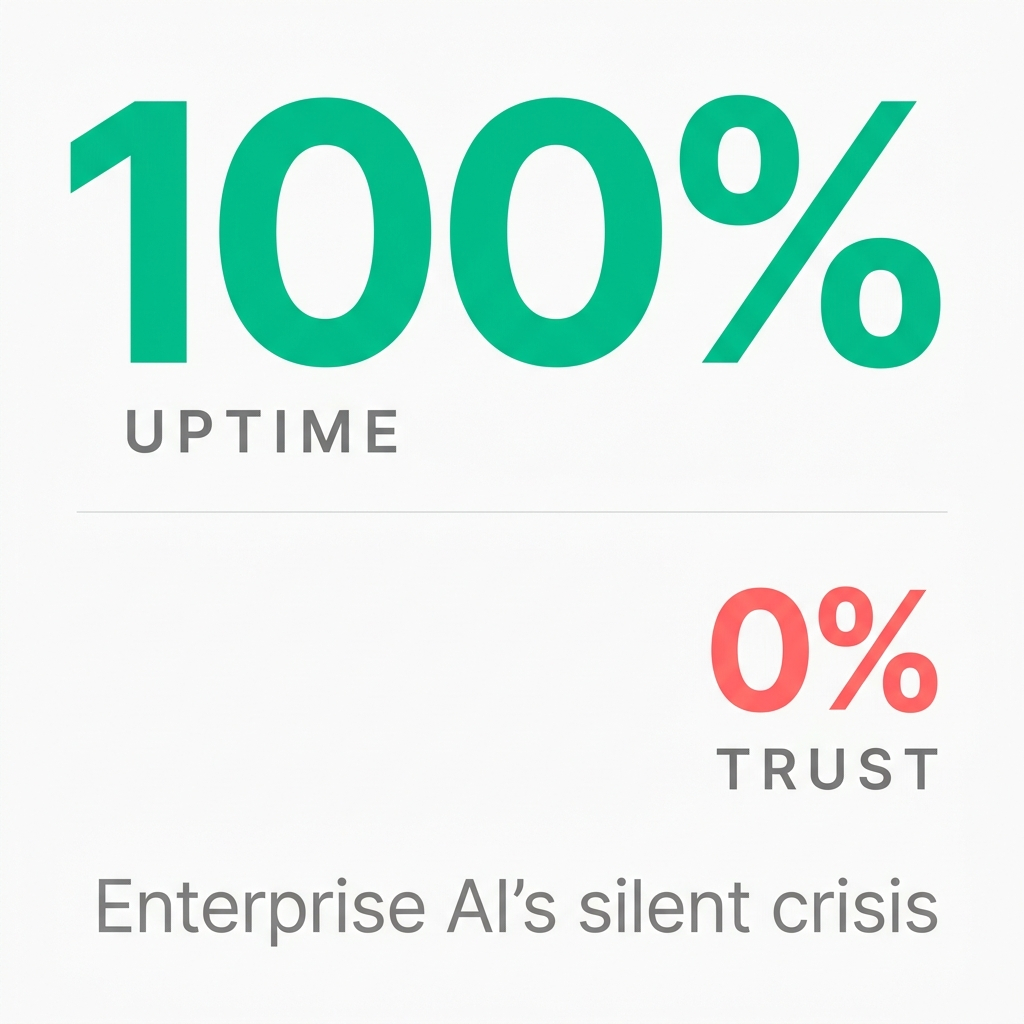
I watched a mid-sized consulting firm implement an agentic AI system for proposal generation and contract compliance. The vendor sold it like magic: connect your data sources, and the system would help with past performance generation and contract review.
The results were different.
The AI produced invalid results—fabricated past performance data—and when asked for a list of contracts meeting specific criteria, it delivered incomplete lists. Sometimes it missed the same contracts. Sometimes it was random. There was no traceability and no way to monitor what the system was actually doing.
The infrastructure looked fine. The behavior was broken.
This is context degradation, and it's the silent killer in enterprise AI deployments.
The System Says It's Working. The System Is Wrong.
Here's what makes context degradation dangerous: your infrastructure metrics show green across the board. Latency within SLA. Throughput normal. Error rate flat.
Meanwhile, the model is reasoning over retrieval results that are six months stale, silently falling back to cached context after a tool call degrades, or propagating a misinterpretation through five steps of an agentic workflow.
Traditional observability was built to answer "is the service up?" Enterprise AI requires answering a harder question: is the service behaving correctly?
The gap between those two questions is where your risk lives.
How Discovery Actually Happens (Spoiler: Too Late)
The consulting firm I mentioned didn't discover the problem through logs or alerts. They discovered it during an important audit question from an insurance agent.
The team wanted a list of contracts meeting specific criteria. They realized there had to be more contracts than what the AI listed. No matter what prompt engineering they tried, the problem persisted.
The reality: there were too many contracts for a search-based RAG tool to reason over with that level of detail at runtime.
This is the pattern. These failures accumulate quietly and surface first as user mistrust, not incident tickets. The system degrades behaviorally before it degrades operationally.
For the fabricated past performance data, discovery was immediate—but only because a serious subject matter expert happened to review the output and recognized it as fiction. How many outputs didn't get that level of scrutiny?
Why RAG Search Fails When It Matters Most
Typical RAG search systems used by most agents to retrieve context on the fly will underperform when asked a question that requires understanding context and relationships between concepts that aren't obvious in the document itself.
Humans infer relationships almost instantly when answering questions. We make connections on the fly.
RAG search systems look for similarity. That works great for simple use cases where the answer is obviously listed in a document. Reasoning models added some capabilities, but it's still a challenge.
How did we discover this? Trial and error, bluntly. There wasn't any log or signal to give us suspicion. The model itself felt pretty confident it found everything.
A graceful halt is almost always safer than a fluent error. Too many systems are designed to keep going because confident output creates the illusion of correctness.
The Cascade Effect: One Wrong Answer, Five Bad Decisions
I've seen situations where one AI reasoning error cascaded through downstream workflows. A customer asked a question about a contract clause. That request was misinterpreted and resulted in a cascade of wrong answers.
Research shows that hallucination rates in legal AI queries can range from 69% to 88% when using state-of-the-art language models. When AI systems are integrated into enterprise workflows, hallucinations create cascading risks that touch operational integrity, regulatory compliance, and organizational reputation.
The pattern across documented cases is the same: the AI sounded confident, the human trusted it, and nobody checked until the damage was done.
Detection and verification aren't optional extras. They're the minimum viable defense.
What Traditional Monitoring Can't See
I've asked Prometheus, Datadog, and similar traditional monitoring tools a specific question they fundamentally can't answer:
Which pieces of organizational knowledge did this agent actually rely on when it produced this answer, and how did it combine them step by step?
These tools can tell you CPU, memory, latency, error rates, and even which endpoint or model was called. But they fundamentally cannot tell you:
- Which proposals, decks, emails, or graph nodes the AI treated as relevant inside your firm's institutional memory
- How it traversed your knowledge graph or workflows—what it looked at first, what it discarded, what it doubled down on
- Where it overrode or ignored your consulting playbooks and methodologies
That's the gap between infrastructure telemetry and behavioral telemetry.
Testing for Behavior, Not Just Response
You stop asking "did it load?" and start asking "did it understand and store this in the right place, with the right meaning and protections?"
For AI systems handling institutional memory, that shifts testing in concrete ways:
From connectivity checks to semantic checks. Instead of "Did we connect to SharePoint and pull N documents?" you test: "For this specific proposal, did the system extract the right client, industry, deal size, outcomes, and link it to the correct project node in the knowledge graph?"
From "no errors" to "no silent corruption." Instead of "The ingestion job finished without exceptions," you test: "Did we drop sections that matter—pricing, risks, lessons learned—because of a parser edge case?"
From throughput to future queryability. Instead of "We can ingest 10k docs/hour," you test: "After ingestion, can a consultant retrieve this case by asking in natural language—and does the system actually hit the right graph slice?"
Research shows that effective context often falls far below advertised limits, by up to 99% on complex tasks. Context degradation isn't gradual—models often maintain good performance until hitting a threshold, then drop sharply.
You need tests that catch that threshold before your users do.
What Behavioral Telemetry Actually Looks Like
When we say we capture what the model actually did with the context, we mean we record a full behavioral trace of the agent:
- Which parts of the firm's knowledge graph it touched
- What intermediate plans and tool calls it made
- Which documents it relied on
- Which fields or artifacts it ultimately changed
Instead of just storing prompts and answers, we log perception, reasoning steps, actions in your stack, and the guardrails that fired.
That gives you replayable, auditable telemetry for every AI-driven workflow.
You can answer questions like: Why did the agent recommend this vendor over that one? Which past projects informed this staffing proposal? What knowledge was missing when it generated that contract clause?
Those aren't infrastructure questions. They're organizational memory questions.
Why This Matters Now
AI systems are moving from assistive tools to autonomous agents embedded in critical workflows. The gap between "the system responded" and "the system behaved correctly" is widening.
Most firms are still operating with infrastructure-era monitoring in a behavior-era problem space.
Context degradation happens invisibly. Discovery happens through downstream consequences—audit failures, compliance violations, client trust erosion.
You need visibility into what the AI actually knows, what it's reasoning over, and where it's making decisions based on incomplete or stale data.
Because the most expensive failures are the ones your monitoring tools never see coming.
What You Can Do About It
Start by asking different questions of your AI systems:
What organizational knowledge did this output depend on? Can you trace the reasoning path from question to answer? When was the underlying context last updated? What happens when a key document is missing or stale?
If you can't answer those questions, you're flying blind.
The firms that adopt behavioral telemetry now get an advantage. The firms that wait get disruption.
And the timeline is shorter than you think.