

Your AI Writes Beautiful Proposals That Say Nothing

I watched a partner at a mid-sized consulting firm spend twenty minutes polishing a proposal introduction that ChatGPT wrote in thirty seconds.
It was fluent. Grammatically perfect. Professionally formatted.
It also contained zero specifics about what his firm had actually done.
No mention of the 2019 project that directly matched the RFP. No reference to the methodology they'd refined over eight years. No acknowledgment that their lead partner spent three years working at the client's competitor and understood their pain points better than anyone.
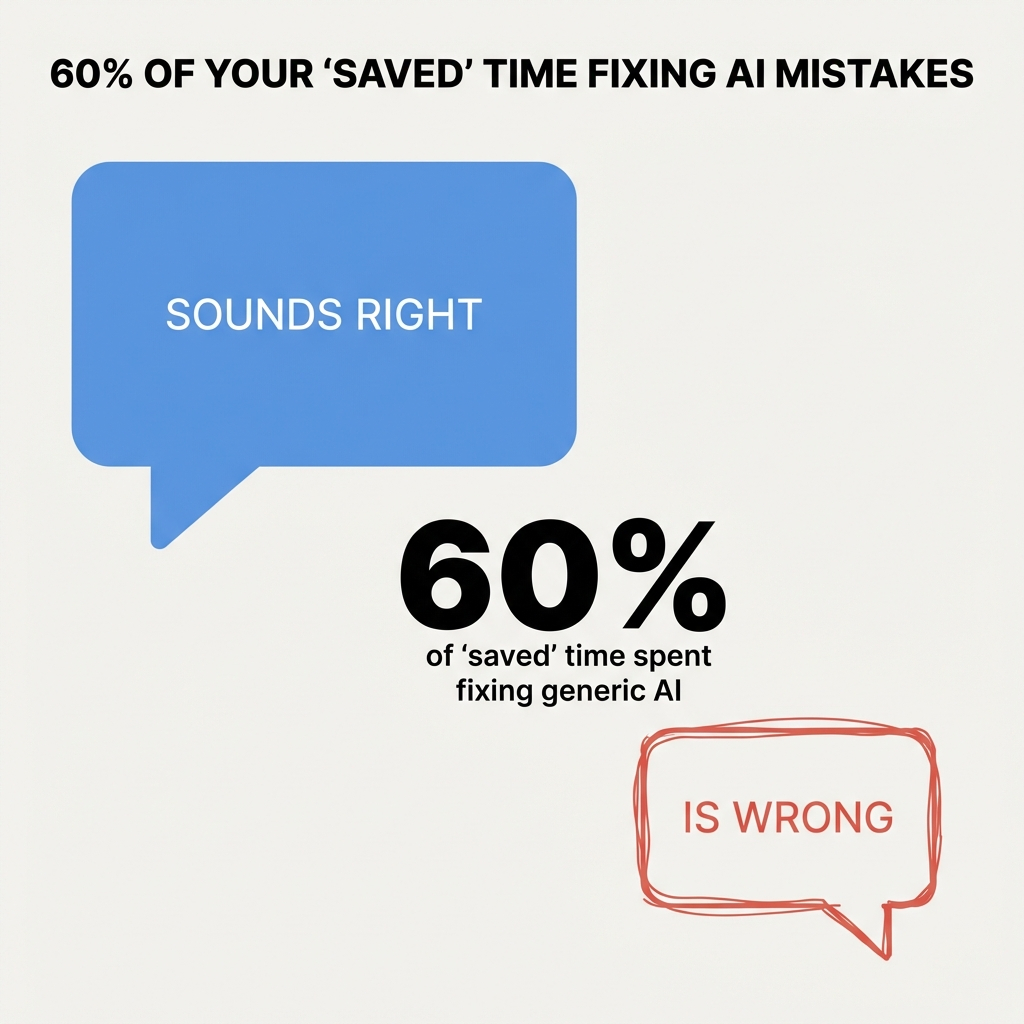
The proposal sounded good. It just didn't say anything true.
This is the gap between fluent and factual. Generic AI tools produce the first. Winning proposals require the second.
The Fluency Trap
ChatGPT and similar tools are remarkable at generating professional-sounding text. They understand grammar, structure, and tone. They can mimic consulting language with impressive accuracy.
What they can't do is access your firm's actual experience.
Studies show ChatGPT hallucination rates range from 3% to 40% depending on the version and task. GPT-4 sits around 3%. GPT-3.5 hits 40%. These aren't small errors in footnotes. These are invented facts, misattributed sources, and plausible-sounding misinformation.
When you're crafting proposals worth hundreds of thousands or millions in potential revenue, a 3% hallucination rate is a deal-breaker.
But the bigger problem isn't hallucination. It's omission.
Generic AI doesn't know about your firm's methodology. It can't reference your past projects. It has no idea which partners have relevant expertise or which team members worked in the client's industry.
It writes fluently about nothing specific.
Why Generic AI Fails at Proposals
When you walk into a professional services firm and a new opportunity comes in, the first thing you do is look back inside. You search for similar experience. You ask who has expertise in that industry. You try to understand if you've solved this problem before.
That process is time-consuming. Most firms don't have an experience database. If they do, it's outdated. An Excel spreadsheet. Some PowerPoints. Maybe a SharePoint library that contains everything and nothing.
For firms that have been in business for decades, narrowing down relevant experience is almost impossible.
People use email. They post on Slack or Teams asking if anyone has done this before. They try to identify experts. They waste hours hunting for scattered expertise.
Then they turn to AI hoping for a shortcut.
But generic AI tools face the same problem. They may use traditional AI search or basic RAG (Retrieval-Augmented Generation). That works to a degree. But it's not good enough to truly narrow down what you've done with high precision.
More importantly, it can't tell you how you solved those problems or what the outcomes were.
The knowledge you need isn't just in documents. It's in meeting transcripts. In your CRM system. In your ERP. Knowledge is scattered across multiple systems, and generic AI can't connect those dots.
The Market Failure Nobody Talks About
Clients report widespread frustration with AI-generated proposals. They're generic. They lack personal touches. They fail to directly answer specific project questions.
This creates what economists call adverse selection. When mediocre talent can produce surface-level polished proposals using free AI, proposal quality stops being a reliable indicator of actual expertise.
High-quality consultants become indistinguishable from low-skilled competitors using identical tools.
The firms that win are the ones that ground their AI in actual institutional knowledge.
What Factual Actually Means
I ran a consulting firm for years. I personally forgot that five years ago we'd solved a specific problem for a similar client. I just couldn't remember it myself.
If one person who built the firm can't remember, imagine what gets lost at scale.
According to IDC, companies lose $31.5 billion annually due to poor knowledge sharing. A firm with 1,000 employees loses $2.4 million in productivity each year. A firm with 30,000 employees loses $72 million.
That's not just inefficiency. That's expertise evaporating.
80% of critical knowledge in companies isn't documented. It's tacit knowledge held in people's heads. 42% of institutional knowledge resides solely with individual employees.
When they leave, nearly half of what your firm knows walks out the door.
Factual AI means grounding your system in this scattered institutional knowledge. Not just documents. Not just past proposals. Everything.
Meeting transcripts where your team discussed client challenges. CRM records showing which partners worked with which industries. Project databases containing outcomes and methodologies. Email threads where experts shared insights.
When you connect to these data sources live and continuously ingest new information, you build what I call Organizational Consciousness. Your firm's collective intelligence becomes accessible.
The Glass Box Difference
Traditional AI search is a black box. It tells you it found ten documents or ten Salesforce records. But it doesn't tell you why.
You can't trace back and understand the reasoning. You have to trust the black box pulled the right content and trust that it was accurate.
That's a problem when building proposals.
When we built Experio, we took a different approach. We use Knowledge Graphs that work like your firm's collective brain.
Think about how humans reason. We have neurons connected to knowledge. When you ask your brain a question, it connects dots. You traverse relationships between concepts.
Knowledge Graphs work the same way. We connect concepts like people, documents, projects, and clients. Those concepts have relationships and meanings.
If John worked on Project ABC, you can see that relationship. When he started. When it ended. What his role was. What expertise he has. What skills he demonstrated. What domain he worked in. What client industry he served.
When you ask who are the experts in financial restructuring who've done work in manufacturing, the system traverses these connections and finds the right people based on actual project history.
You can trace the path. You can see visually how the system reasoned.
That's transparency. That's auditability. That's how you build trust.
What Changes When AI Knows Your Firm
Our pilot customers report 60-80% time savings in proposal development. But that's not the most important metric.
The transformation happens in stages.
First comes the recognition. Partners who've been at the firm for decades suddenly remember projects they'd forgotten. They discover expertise they didn't know existed in their own organization.
One partner told me he'd completely forgotten about a project from five years ago that was directly relevant to a current RFP. Even someone who built the firm couldn't keep it all in their head.
At scale, that memory loss is catastrophic.
Second comes team assembly. Instead of picking whoever is available or whoever helped you write proposals before, you can identify who actually has relevant expertise.
You're not constrained by availability or familiarity. You're guided by actual experience.
Third comes speed. Getting that first draft out is the hardest part of proposal development. When your AI can pull from your firm's actual experience, that first draft writes itself.
Not with hallucinated content. Not with generic consulting language. With your voice, your experience, your expertise.
Fourth comes quality control. Before proposals go out, there's typically a layer of approval. AI can distill what the proposal says, identify gaps, check if you answered the questions correctly, and verify consistency with how you've done things before.
That proposal intelligence increases win rates.
The Implementation Reality
The biggest objection we hear is "we're too busy."
Teams are so swamped writing proposals inefficiently that they don't have time to fix the proposal process.
That's why we developed a proof-of-value pilot. Sixty days maximum. A couple weeks for setup and deployment. Connect to the data sources relevant for proposal generation. Then take one or two actual proposals as test cases.
You invest time to see the value. If it works, you move forward. If it doesn't, you've only spent sixty days.
The setup is straightforward. We connect live to your document management systems. SharePoint, Box, Google Drive. Places where you store meeting transcripts. Your CRM. Your ERP.
We push a button and ingest everything into your digital brain. Content gets extracted, enriched, and new concepts get inferred. We create a digital map of your institutional knowledge.
That takes a few weeks. There's configuration around terminology. We make sure the system speaks your language, not generic AI language.
Then you're live.
What Winning Looks Like
Better proposals arrive faster. That's the surface benefit.
The deeper transformation is organizational. You stop losing expertise when people leave. You stop wasting hours searching for information that should be instantly accessible. You stop assembling teams based on availability instead of capability.
You start operating like your firm actually knows what it knows.
BCG ran experiments showing 30-40% efficiency gains for junior analysts and 20-30% gains for experienced staff when using AI properly. But they also saw a 23% performance drop on complex tasks when AI was used without sufficient critique.
The difference is grounding. AI that knows your firm's actual experience performs. AI that hallucinates or generates generic content fails.
Fluency without facts is worse than useless. It's dangerous.
When you ground AI in institutional knowledge, you're not replacing people. You're preserving what makes them irreplaceable.
The Category That's Forming
We're past the phase where AI is a novelty. We're entering the phase where AI becomes infrastructure.
The firms that recognize this early gain an advantage. The firms that wait face disruption.
Organizational Consciousness isn't a feature. It's a category. It's the difference between firms that learn and firms that repeat. Between firms that retain expertise and firms that lose it with every departure.
Generic AI will keep getting better at sounding fluent. But fluency was never the problem.
The problem is access to what your firm actually knows.
When you solve that, proposals become faster, teams become smarter, and expertise stops evaporating.
That's not a productivity hack. That's infrastructure.
And infrastructure is what separates firms that scale from firms that struggle.