

Building Organizational Consciousness: The Four Capabilities That Make Memory Infrastructure

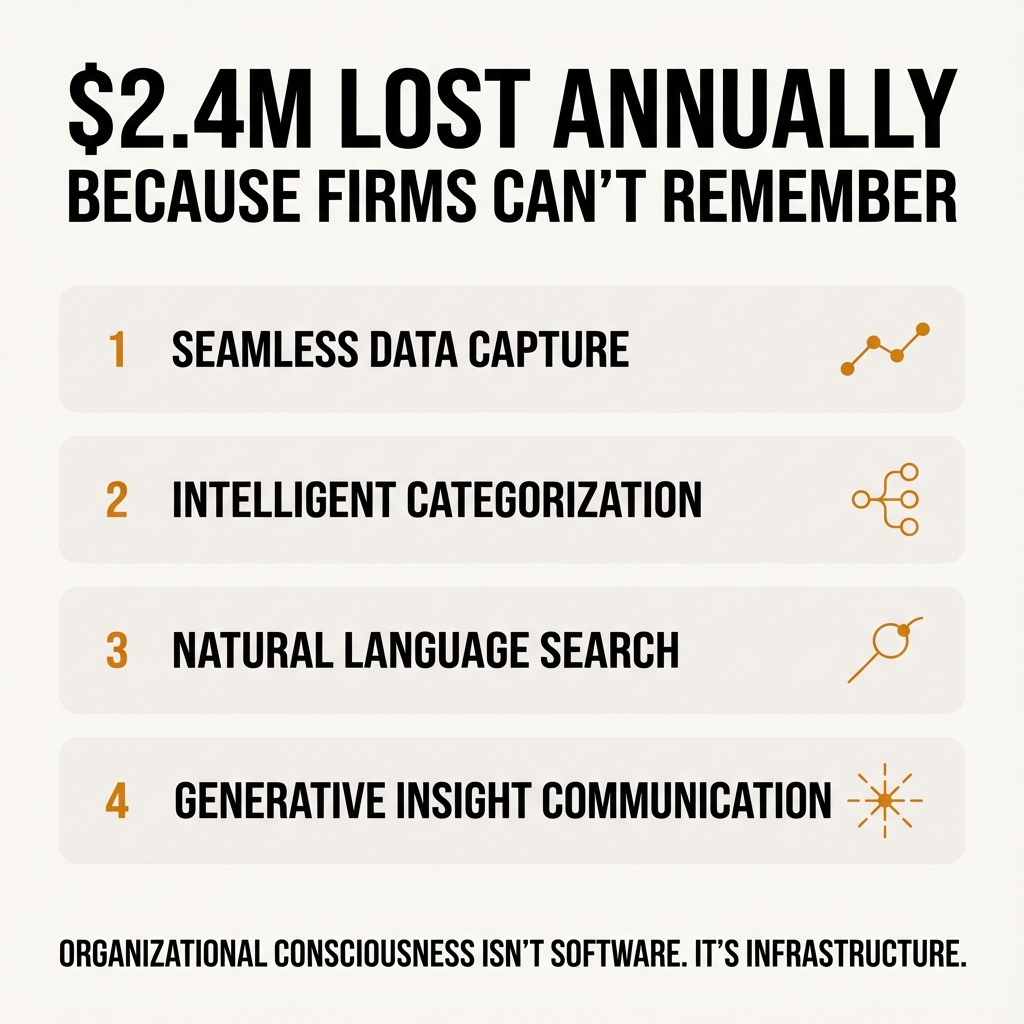
I've watched consulting firms lose $2.4 million annually in productivity because they can't remember what they already know.
The numbers are brutal. 42% of institutional knowledge lives only in individual heads. When those people leave, nearly half of what your firm could do simply vanishes. You're not just losing employees. You're losing the ability to execute.
This isn't a people problem. It's an infrastructure problem.
Organizational consciousness doesn't emerge from better documentation or more disciplined knowledge sharing. It emerges from four specific AI-powered capabilities working together as a system. I'm going to show you how these capabilities transform scattered expertise into accessible infrastructure.
Capability One: Seamless Data Capture From Diverse Sources
Your knowledge exists everywhere and nowhere.
Proposals live in SharePoint. Client conversations happen in Slack. Project retrospectives sit in someone's notebook. Methodology refinements exist as tribal knowledge passed between senior consultants and their teams.
The first capability is continuous, automatic ingestion from every source where expertise actually lives. Not monthly uploads. Not manual tagging. Real-time capture that treats your entire operational footprint as the knowledge base it actually is.
This means your AI infrastructure connects to:
- Document repositories (SharePoint, Google Drive, Confluence)
- Communication platforms (Slack, Teams, email)
- Project management systems (Asana, Jira, Monday)
- CRM and client interaction records
- Meeting transcripts and recordings
- Internal wikis and knowledge bases
The technical architecture matters less than the principle: if expertise flows through it, the system captures it.
Without this foundation, you're building on quicksand. You can't create organizational memory from data you don't have.
Capability Two: Intelligent Categorization and Taxonomy Management
Capture without structure is just a bigger pile.
Most firms treat categorization as a human problem. Someone needs to tag documents. Someone needs to maintain folder hierarchies. Someone needs to decide what goes where.
That someone never has time, and the system degrades immediately.
The second capability is AI-driven taxonomy that learns your firm's actual knowledge structure. Not the org chart you wish you had. The one you actually use when you need to find something.
This means the system:
- Automatically identifies topics, themes, and expertise domains
- Recognizes relationships between concepts across documents
- Builds semantic connections that mirror how your people think
- Adapts classification as your practice evolves
- Surfaces hidden patterns in how knowledge clusters
When a new proposal gets written, the system doesn't ask where to file it. It understands what it is, how it relates to previous work, and who needs to know about it.
This is where static document management dies and organizational consciousness begins.
Independent benchmarking shows that without strong semantic grounding, AI accuracy collapses. You can't skip this layer and expect the system to work.
Capability Three: Natural Language Search and Retrieval
Your people don't search for documents. They search for answers.
When someone asks "How did we handle the pricing model on that healthcare engagement last year?" they're not looking for a file. They're looking for the decision logic, the tradeoffs considered, and the outcome that resulted.
The third capability is contextual retrieval that understands intent, not keywords.
This transforms search from archeology into conversation. Your team asks questions the way they think about problems, and the system returns the institutional knowledge that actually answers them.
The technical difference is profound:
- Traditional search matches words in documents
- RAG systems retrieve relevant passages from indexed content
- Stateful AI understands what you're actually trying to solve
When your senior consultant asks about pricing models, the system knows they're three weeks into a similar engagement. It surfaces not just past proposals, but the lessons learned, the client objections encountered, and the refinements made since then.
Context isn't a feature. It's the entire point.
McKinsey found that employees lose nearly 8 hours weekly searching for information. Organizations that implement intelligent retrieval improve search time by 30-35%. That's not productivity optimization. That's reclaiming a full workday per person per week.
Capability Four: Generative AI for Insight Communication
Finding the right knowledge matters only if you can use it.
The fourth capability closes the loop. Generative AI translates institutional memory into actionable communication tailored to the moment someone needs it.
This means your system doesn't just retrieve past proposals. It generates:
- Client-ready executive summaries adapted to current context
- Onboarding materials personalized to role and project
- Methodology guidance that incorporates recent learnings
- Proposal sections that reflect your firm's actual approach
- Risk assessments based on historical outcomes
The average consulting firm sees 9:1 ROI from knowledge management based on time savings alone. But that's table stakes.
The real value is compounding intelligence. Every engagement makes the next one smarter. Every lesson learned becomes immediately accessible. Every refinement propagates across the organization.
When AI can remember and contextualize organizational knowledge, you reduce onboarding time, eliminate repeated mistakes, and preserve best practices that would otherwise evaporate with tenure.
How These Capabilities Create Consciousness
Here's what changes when all four capabilities work together:
Your new hire asks how to structure a change management proposal. The system doesn't point them to a template. It generates a draft incorporating your firm's methodology, recent client feedback, pricing models that worked, and objection handling that succeeded.
Your practice leader wonders if you've solved a particular technical problem before. The system doesn't return a document list. It synthesizes every instance where your team encountered that problem, the approaches tested, and the outcomes measured.
Your business development team prepares for a pitch. The system doesn't offer generic talking points. It surfaces relevant case studies, anticipates likely questions based on similar clients, and suggests positioning based on what actually won deals.
This is organizational consciousness. Not because the AI is sentient. Because your firm's collective intelligence is finally accessible, contextual, and compounding.
The Infrastructure Decision
You're facing a choice that looks like technology but functions like strategy.
Organizations that succeeded with AI invested 50-70% of their budgets in foundations before scaling models. The firms that failed skipped the infrastructure and went straight to chatbots.
Memory is infrastructure, not a feature.
When you build these four capabilities as a system, you're not implementing software. You're installing the substrate that determines whether your firm learns or repeats.
The consulting firms that recognize this early get an advantage. The ones that wait get disrupted by their own knowledge loss.
And the timeline is shorter than you think.