

Consulting Amnesia: Why Your Firm Keeps Solving Problems It Already Solved

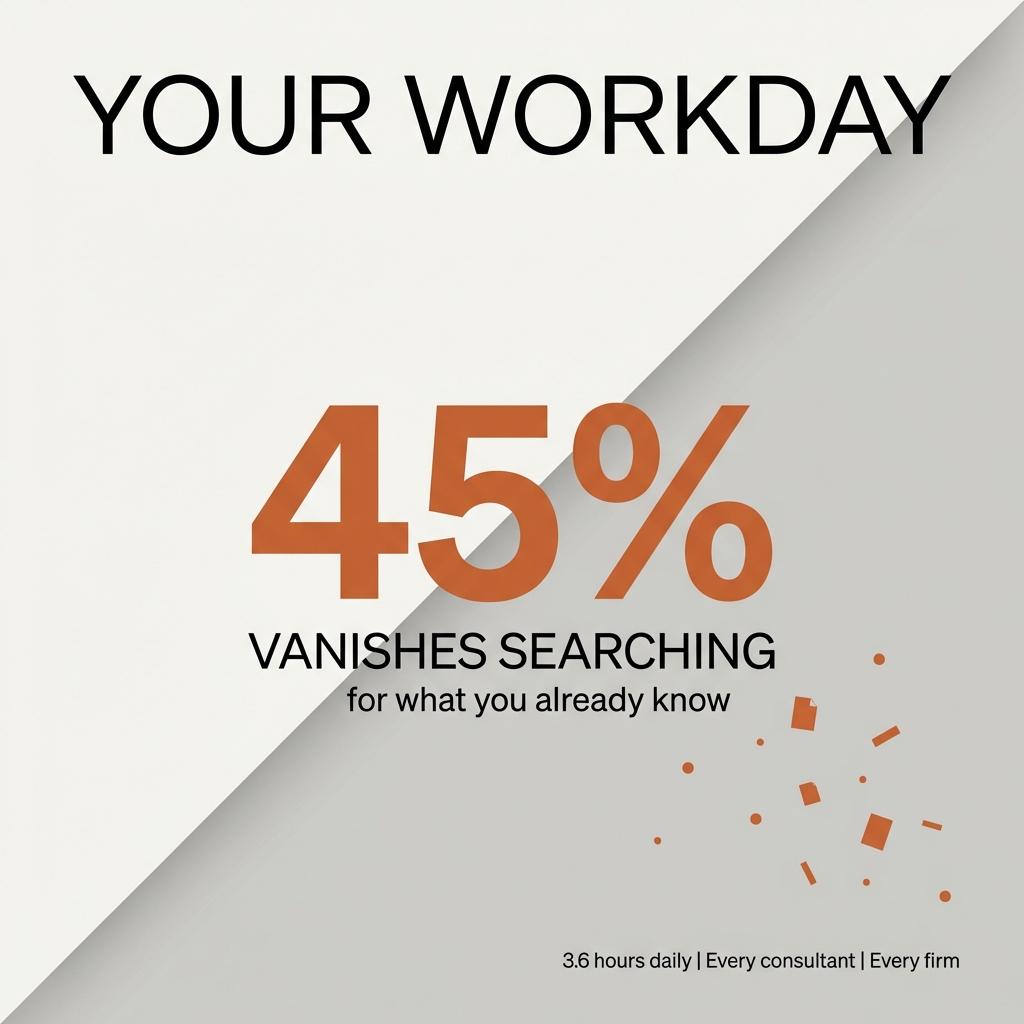
Your senior partner just spent three hours searching for a case study you completed two years ago.
The proposal team reinvented an entire methodology that exists in someone's SharePoint folder from 2019.
A new hire asked on Teams if anyone has experience in manufacturing restructuring. Five people who've done exactly that work never saw the message.
This happens every single day in professional services firms. You call it normal. I call it Consulting Amnesia.
After running a consulting firm and watching this pattern repeat across dozens of organizations, I've realized something: employees spend 1.8 hours each day searching for information. That's 25% of a working day lost to digital archaeology.
Think about that. You hire five consultants, but only four contribute value. The fifth is always searching instead of solving.
The Real Cost of Institutional Forgetting
Most firms treat this as a workflow problem. It's not. It's a structural failure in how knowledge-intensive businesses operate.
Here's what actually happens when institutional memory lives in scattered drives and departed employees' heads:
The new hire spends 200 hours working inefficiently. They ask colleagues for information, wait for responses, figure things out through trial and error, and recreate what their predecessor already built. Every single new consultant goes through this.
Your best expertise walks out the door regularly. More than a third of consulting professionals plan to look for a new role this year. When they leave, 80% of their knowledge goes with them because it was never captured.
You pay people to search, not solve. The average small firm loses $2.4 million annually to insufficient knowledge sharing. Mid-sized consultancies lose up to £15 million to bench inefficiency alone.
You're not running a consulting firm. You're running an expensive game of telephone where the message degrades with every handoff.
Why Generic AI Makes This Worse
I've watched firms try to fix this with ChatGPT or traditional AI search tools. They load up their past proposals and think they've solved the problem.
They haven't.
Generic AI tools operate on similarity matching. They find documents that look related to your query. But they miss the context that actually matters.
When you ask "Who has manufacturing restructuring experience?" a document search gives you files with those keywords. What you actually need is the person who led that engagement, understands the specific challenges, and can speak to the outcomes with data.
That information doesn't live in proposal documents. It lives in your CRM system, meeting transcripts, project databases, and the collective memory of your team.
Generic tools can't connect those dots. They don't know John worked on Project ABC from March to September, specialized in financial restructuring, and achieved measurable results in the manufacturing sector.
They just know John's name appears in some documents.
The Memory-Driven Consultant
What if your firm's collective history became an active partner in every proposal, pitch, and client conversation?
Not a search tool. Not a document repository. An intelligence layer that actually understands what your organization knows and how to deploy that knowledge precisely when needed.
I've seen this transformation happen in our pilot customers. The pattern is consistent:
First comes the recognition moment. A partner who's been with the firm for decades discovers work they'd completely forgotten. "Oh my god, we solved this exact problem five years ago." Even one person can't remember everything they've personally done, let alone what the entire firm knows.
Then comes the team mobilization shift. Instead of assembling proposal teams based on who's available or who you always work with, you can identify who actually has relevant expertise. The right person for the work, not just the free person or the familiar person.
Finally comes the speed transformation. Getting that first draft out stops being the hardest part of proposal writing. You start with your actual experience, your actual voice, your actual expertise. No hallucinations. No making things up. Just what you've genuinely done, organized and accessible.
Our pilot customers report 60-80% time improvements. But the bigger shift is qualitative. Less friction. Fewer revisions. No more frustration with poorly written proposals that don't reflect what the firm actually knows.
How Knowledge Graphs Change Everything
Your brain doesn't store information in folders. It creates connections between concepts, experiences, and people.
That's exactly how a knowledge graph works.
When you deploy a system that maps your institutional knowledge, it creates a digital brain of your organization. People connect to projects. Projects connect to clients. Clients connect to industries. Skills connect to outcomes.
When someone asks "Who are the experts in financial restructuring who've done work in manufacturing?" the system doesn't search for keywords. It traverses these connections and finds the actual experts based on their project history, role specifics, and demonstrated outcomes.
This isn't about replacing human memory. It's about augmenting it with the collective intelligence that already exists in your firm but remains dormant because it's scattered and inaccessible.
The Transparency Problem
Traditional AI search operates as a black box. It tells you it found ten relevant documents, but it won't tell you why it chose those documents or how it reasoned through your query.
You have to trust the algorithm without understanding its logic.