

The Hidden Tax Killing Your Margins (And How to Fix It)
I spent three decades watching smart people make decisions with half the information they needed.
Not because they were lazy. Not because the information didn't exist.
Because it was trapped in someone else's head, buried in a folder structure three layers deep, or locked in a Slack thread from eight months ago.
The Math Nobody Wants to Face
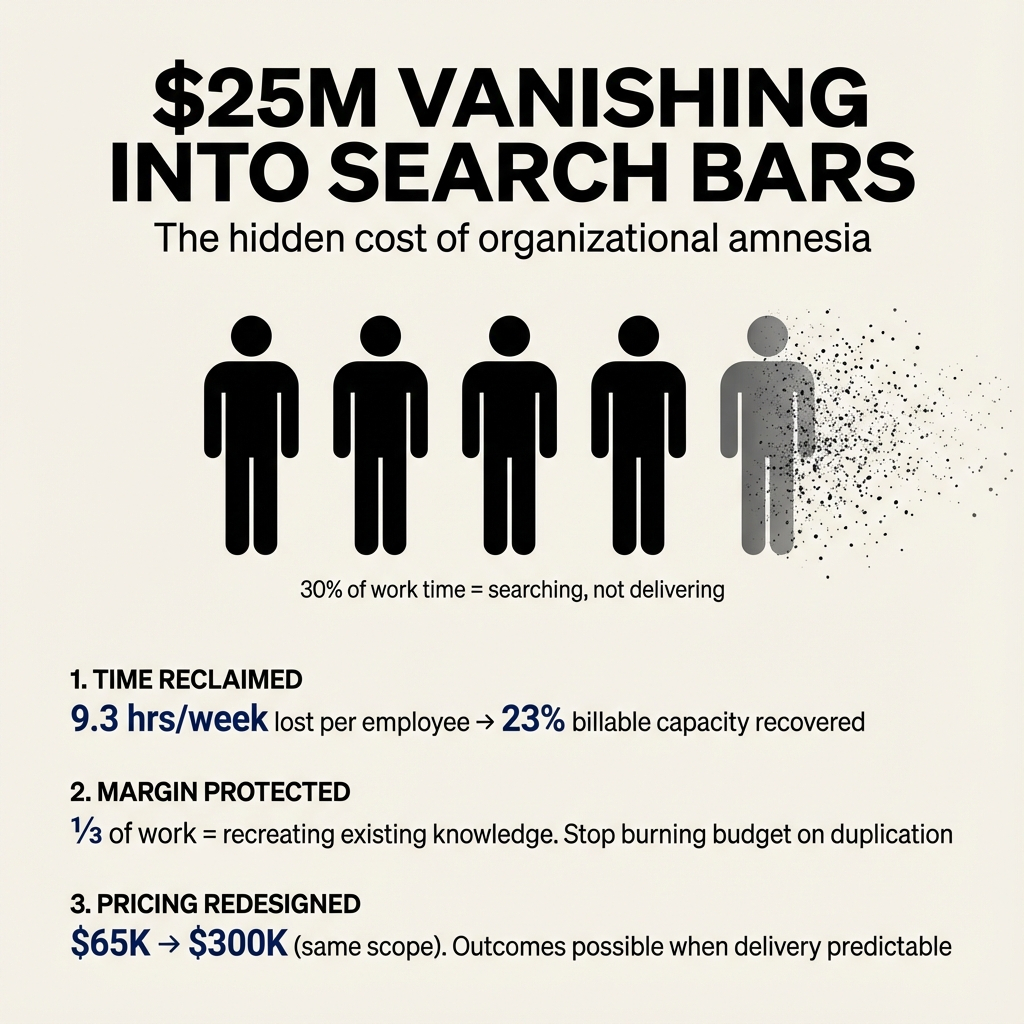
Your employees spend 1.8 hours every day searching for information. That's 9.3 hours per week. If you hire five people, only four show up to work. The fifth is off hunting for answers that already exist somewhere in your organization.
Knowledge workers waste another 5.3 hours weekly either waiting for information from colleagues or recreating work that someone already completed. The average large business loses $47 million annually in productivity because of inefficient knowledge sharing.
But here's what keeps me up at night: 42% of institutional knowledge lives exclusively in individual employees' heads. When they leave, your firm loses the ability to handle nearly half of what it used to do.
Decision Stress Is a Symptom, Not the Disease
I talk to practice leaders every week who tell me the same thing. Their teams are drowning.
85% of business leaders experience decision stress. 75% report a tenfold increase in daily decision volume over the past three years. The pressure is real.
But the problem isn't the volume of decisions. It's the quality of context available when those decisions get made.
When your senior consultant makes a call on a client engagement, they should have instant access to every similar project your firm has ever completed. Every lesson learned. Every mistake avoided. Every successful approach.
Instead, they're making educated guesses based on whatever they personally remember or whoever happens to respond to their Slack message.
The Knowledge Gap Between What You Know and What You Can Access
Your firm knows more than any individual in it. That's supposed to be the advantage of building an organization.
But if that collective intelligence stays scattered across brains, drives, and databases, you're operating like a solo practitioner at enterprise scale.
I've seen this pattern repeat at every firm I've worked with:
Senior consultants hold project-based expertise. They know what worked on specific engagements, which clients responded to which approaches, where the landmines are buried.
Middle managers hold operational knowledge. They understand the firm's routines, the unwritten rules, the workarounds that make things actually function.
When either group leaves, you don't just lose a person. You lose the architectural knowledge that holds your operation together.
Replacing a single employee can cost up to 213% of their salary because it takes up to two years to get a new hire to the same efficiency level. And that's just the direct cost. The indirect cost is every suboptimal decision made during those two years because the new person doesn't know what the old person knew.
What Organizational Consciousness Actually Means
I'm not talking about building a better search tool or implementing another knowledge management system that nobody uses.
I'm talking about creating an organization that remembers.
When your team makes a decision, they should have access to the full context that decision requires. Not just documents. Not just data. The accumulated wisdom of every similar situation your firm has navigated.
Organizations with robust knowledge management programs see their employees spend 4.6 hours searching weekly instead of 8.5 hours. That's 3.9 hours per employee saved every week. That time doesn't just improve productivity. It improves the quality of thinking that happens during those recovered hours.
High-quality contextual information serves as a strategic asset. It empowers organizations to make informed decisions and adapt to changing conditions. It turns institutional knowledge from a nice-to-have into infrastructure.
The Firms That Figure This Out First Win
I'm watching a divide form in the consulting industry.
Some firms are treating knowledge loss as an inevitable cost of doing business. They accept that expertise evaporates. They build processes around the assumption that information will stay fragmented.
Other firms are recognizing that memory is infrastructure. They're building systems that capture what people know, make it accessible when decisions get made, and preserve it when people leave.
The gap between these two groups will compound over time.
The firms that solve organizational consciousness don't just operate more efficiently. They make better decisions. They onboard faster. They retain knowledge that competitors lose. They turn collective intelligence from a theoretical advantage into an operational reality.
73% of CEOs expect a shortage of workers or skills to disrupt their business. 51% say retaining talent is one of their biggest challenges.
You can't control whether people leave. But you can control whether what they know leaves with them.
What This Looks Like in Practice
A practice leader at a mid-sized consulting firm told me something last month that stuck with me.
"We have 200 people who have collectively solved thousands of problems. But when someone hits a new challenge, they're starting from zero because they can't access what we already figured out."
That's the gap. That's what organizational consciousness closes.
When your team can instantly surface relevant past projects, access decision frameworks that worked in similar contexts, and learn from approaches that failed before, decision quality improves across the board.
You're not replacing human judgment. You're giving it the context it needs to be accurate.
The Infrastructure Question
Most firms are optimizing workflow when they should be building memory systems.
The question isn't how to make your current processes 10% more efficient. The question is whether your organization can remember what it learns.
Because if it can't, you're not building institutional value. You're renting expertise and watching it walk out the door every time someone leaves.
The firms that treat memory as infrastructure will outperform the firms that treat it as a nice-to-have. Not by a small margin. By an order of magnitude.
That's what I'm building toward. That's what organizational consciousness makes possible.