

The Six Bottlenecks Killing Your Proposal Win Rate

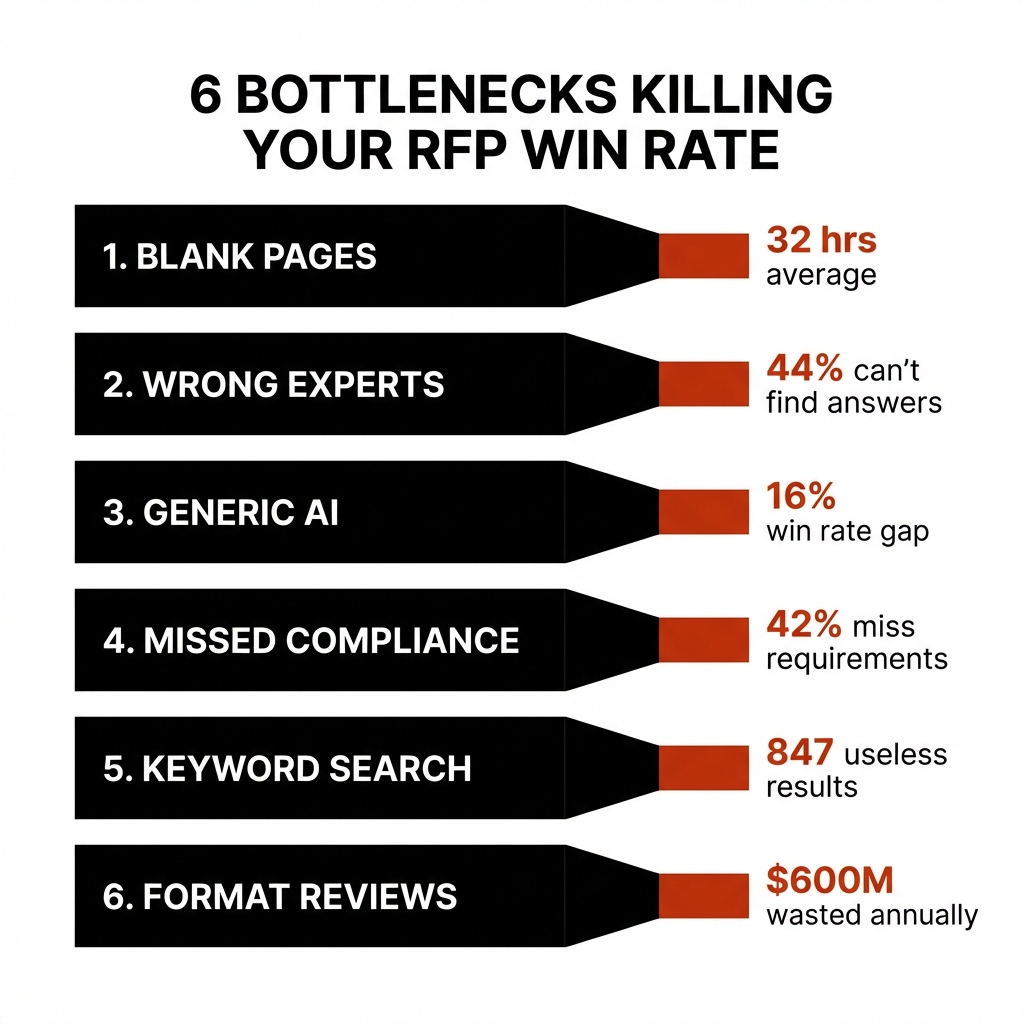
I ran a consulting firm for years. I've watched brilliant partners waste entire afternoons hunting for a project description they know exists somewhere. I've seen teams mobilize the wrong experts because they picked based on availability instead of actual experience. I've reviewed proposals that read like they were written by someone who'd never worked at the firm.
The proposal process isn't just slow. It's systematically wasteful.
Most firms accept this as normal. They treat the chaos as a cost of doing business. But when firms lose 80,000 hours annually on unnecessary proposal work, and companies waste $31.5 billion each year due to poor knowledge sharing, you're not looking at a workflow problem. You're looking at a structural failure.
Here are the six bottlenecks that slow every proposal—and what it takes to actually fix them.
Bottleneck 1: Building from Blank Pages Instead of Best Work
Every proposal starts the same way. Someone opens a blank document and stares at it.
They know the firm has done similar work before. They remember seeing a case study that would be perfect. But where is it? SharePoint? An old email? Someone's local drive?
The average RFP response takes 32 hours to write. A significant portion of that time gets burned searching for content that already exists.
This isn't a search problem. It's a memory problem.
Your firm has decades of experience. Thousands of projects. Hundreds of successful proposals. But when someone needs to reference that work, they're starting from scratch because the institutional memory doesn't exist as infrastructure.
What This Actually Costs You
When your team can't access past work, they recreate it. Badly.
They write generic descriptions of capabilities instead of specific examples of outcomes. They describe what you could do instead of what you've done. The proposal sounds fluent but lacks the grounding that wins work.
Worse, you're paying senior people to do junior work. Partners who should be refining strategy are hunting through file systems.
The Fix: Institutional Memory as Infrastructure
The solution isn't better search. It's treating your firm's collective knowledge as a system that remembers.
When I built Experio, I designed it to connect directly to where your knowledge actually lives. Document management systems. Meeting transcripts. CRM records. ERP data. The system ingests everything, extracts the context, and builds a digital map of your institutional knowledge.
You don't organize files. You don't tag documents. The system learns your firm's language and creates connections between projects, people, expertise, and outcomes.
When someone starts a proposal, they're not building from a blank page. They're building from your firm's best work.
Bottleneck 2: Mobilizing by Job Title Instead of Actual Expertise
You get a new opportunity. You need to assemble a team.
Who do you pick?
Most firms default to the same pattern. They pick whoever responded to the Slack message. They pick the partner who always helps with proposals. They pick based on availability, not expertise.
This happens because finding the right expert is harder than finding an available one.
Even in a firm with 500 people, you can't remember who worked on that financial restructuring project three years ago. You can't recall who has deep experience in manufacturing. You definitely don't know who successfully solved a similar problem for a client in a different division.
So you pick who you know. And you leave your best expertise on the bench.
What This Actually Costs You
When you mobilize the wrong team, you write the wrong proposal.
You miss the nuanced experience that would differentiate your response. You can't demonstrate specific outcomes because the people writing the proposal weren't involved in the relevant work. Your proposal reads like a capabilities statement instead of proof.
The client reads it and thinks: "They seem qualified, but have they actually done this before?"
The Fix: Knowledge Graphs That Map Actual Expertise
Traditional org charts show reporting structure. Knowledge Graphs show who actually knows what.
When you ask "Who are the experts in financial restructuring who've done work in manufacturing?" the system doesn't search job titles. It traverses connections between people, projects, skills, industries, and outcomes.
It shows you John worked on Project ABC from 2021-2023. His role was lead analyst. He has expertise in financial restructuring. He worked in the manufacturing industry. The project achieved a 40% cost reduction for the client.
You're not guessing based on memory. You're seeing the actual map of expertise that exists across your firm.
This is how you mobilize the right team instead of the available team.
Bottleneck 3: Drafting Generic Content Instead of Grounded Past Performance
Most proposals sound the same.
"We have extensive experience in..."
"Our team of experts will leverage..."
"We are uniquely positioned to..."
These statements aren't wrong. They're just not specific enough to be convincing.
The problem isn't writing ability. It's access to the details that make proposals credible.
When someone drafts a proposal without direct access to past performance data, they write in generalities. They describe capabilities instead of outcomes. They use impressive language instead of specific evidence.
The proposal sounds professional. But it doesn't prove you've done this before.
What This Actually Costs You
Generic proposals don't win competitive bids.
When nearly 70% of consultants win less than 60% of their proposals, you're competing against firms that can demonstrate specific, relevant experience.
The client isn't choosing based on who sounds most qualified. They're choosing based on who proves they've solved this exact problem before.
The Fix: Semantic Search That Understands Context
Traditional keyword search fails because it matches words, not meaning.
Search for "financial restructuring" and you get every document that contains those words. You don't get the projects where you actually performed financial restructuring but called it something else. You miss the meeting transcripts where the client described the outcome. You lose the CRM notes that explain why the approach worked.
Semantic search understands context. It finds relevant experience even when the exact terminology differs. It surfaces the project where you "optimized capital structure" because it recognizes that's functionally the same as financial restructuring.
When you draft proposal content, you're pulling from actual past performance. Not generic descriptions. Not hopeful capabilities. Specific projects with specific outcomes.
Your proposal shifts from fluent to factual.
Bottleneck 4: Missing Compliance Requirements Buried in RFP Language
RFPs are dense. Requirements hide in paragraph 47 of section 12. Compliance criteria appear in footnotes. Evaluation factors get scattered across multiple documents.
Your team reads through it. They think they caught everything. Then the proposal gets rejected because you missed a formatting requirement or didn't address a specific evaluation criterion.
This happens constantly.
Not because your team is careless. Because human attention can't reliably track 200 compliance points across 80 pages of dense procurement language.
What This Actually Costs You
Missing a compliance requirement doesn't just weaken your proposal. It disqualifies you entirely.
You spent weeks assembling the team. You pulled together case studies. You drafted compelling content. Then you get eliminated in the first review because you didn't include a required certification or missed a page limit buried in the instructions.
The work was wasted before anyone evaluated your qualifications.
The Fix: Glass Box AI That Shows Its Work
Most AI tools are black boxes. They give you an answer but don't show you how they got there.
You can't trust a black box with compliance. You need to see the reasoning.
Glass Box AI works differently. When it identifies compliance requirements, it shows you exactly where each requirement appears in the RFP. It traces the path through the document. It highlights the specific language that triggered the requirement.
You're not trusting an algorithm. You're following a clear trail of evidence.
When the system says "Section 3.4 requires three professional references with contact information," it shows you section 3.4. You can verify the interpretation. You can see the exact requirement in context.
This is how you catch what human attention misses without introducing new risk.
Bottleneck 5: Keyword Search Failing to Surface Relevant Experience
You need to find projects where you've worked with healthcare clients on digital transformation.
You search your document repository for "healthcare digital transformation." You get 47 results. Half are irrelevant. The other half are outdated. The perfect project example doesn't appear because it was filed under "health system modernization."
Traditional search matches words. It doesn't understand meaning.
This creates two problems. You find too much irrelevant content. And you miss the relevant content that uses different terminology.
What This Actually Costs You
When search fails, your team either wastes time sorting through irrelevant results or gives up and writes generic content.
The experience exists in your firm. The case study is sitting in a folder somewhere. But if you can't find it, it might as well not exist.
You end up writing "We have experience in healthcare" instead of "We helped Regional Health System reduce patient wait times by 40% through a three-phase digital transformation."
The difference between those statements is the difference between winning and losing.
The Fix: Semantic Search That Understands Intent
Semantic search doesn't match keywords. It understands what you're actually looking for.
When you search for "healthcare digital transformation," the system recognizes you're looking for projects involving medical organizations and technology modernization. It finds the project filed under "health system modernization" because it understands those concepts are related.
It also finds the meeting transcript where the client described the outcome. The CRM note that explains why the approach worked. The proposal that won the original work.
You're not searching files. You're querying institutional knowledge.
The system connects concepts across different data sources and surfaces everything relevant to your actual intent, not just what matches your exact words.
Bottleneck 6: Partners Reviewing Formatting Instead of Strategy
Your most expensive people spend their time on your least valuable work.
Partners review proposals to catch typos. They fix formatting inconsistencies. They verify that section headers match the RFP requirements. They check that the font is correct and margins are consistent.
This is necessary work. But it shouldn't require partner-level attention.
The problem is that by the time proposals reach final review, partners don't have time to evaluate strategy. They're doing quality control on execution details because those details matter for compliance.
But this means the strategic review gets compressed or skipped entirely.
What This Actually Costs You
When partners review formatting instead of strategy, you submit compliant proposals that lack strategic differentiation.
The proposal meets all requirements. The formatting is perfect. But the positioning is weak. The win themes aren't sharp. The value proposition doesn't resonate.
You're technically qualified but strategically undifferentiated.
The Fix: AI That Handles Compliance So Humans Can Focus on Strategy
AI should handle what it's good at so humans can focus on what they're good at.
AI is excellent at checking compliance. It can verify that every RFP requirement has been addressed. It can confirm formatting matches specifications. It can catch inconsistencies across sections.
Humans are excellent at strategy. They can evaluate whether the proposal tells a compelling story. They can assess whether the positioning differentiates from competitors. They can refine the value proposition.
When AI handles compliance checking, partner review time shifts from quality control to strategic refinement.
The proposal gets stronger where it actually matters.
What Changes When You Fix All Six
I've watched this transformation happen with our pilot customers.
They start proposals from their firm's best work instead of blank pages. They mobilize the right experts instead of whoever responds first. They draft with specific past performance instead of generic capabilities. They catch compliance requirements that human attention misses. They find relevant experience even when terminology varies. Partners review strategy instead of formatting.
The result isn't just faster proposals. It's better proposals.
Our pilot customers report 60-80% time savings. But the bigger impact is the reduction in friction and frustration. People aren't stressed about finding information. They're not recreating work that already exists. They're not worried about missing compliance requirements.
They're confident the proposal represents their firm's actual capabilities.
The Real Problem Isn't Workflow
Most firms try to fix proposal problems with better workflow tools.
They implement collaboration platforms. They create templates. They establish review processes. These help at the margins.
But they don't solve the underlying problem.
The problem is that your firm's collective knowledge exists but isn't accessible. Expertise is trapped in individual memories. Experience is scattered across disconnected systems. Past performance is buried in documents that can't be found.
You're not facing a workflow problem. You're facing a memory problem.
When I built Experio, I designed it to treat institutional memory as infrastructure. Not as a nice-to-have feature. As the foundational layer that everything else depends on.
The system connects to your existing data sources. It builds a knowledge graph that maps relationships between people, projects, expertise, and outcomes. It maintains that knowledge in near real-time so it never becomes outdated.
You're not implementing a proposal tool. You're installing organizational memory where none existed before.
Why This Matters Now
The firms that recognize institutional memory as infrastructure will have an advantage.
The firms that continue treating it as disposable will face increasing disadvantage.
As AI becomes commoditized, differentiation moves to what the AI knows. Generic AI tools can write fluent content. But they can't access your firm's specific experience unless that experience exists as structured, accessible knowledge.
The gap between firms with institutional memory infrastructure and firms without it will widen rapidly.
You can see this in proposal win rates. The firms that demonstrate specific, relevant past performance win competitive bids. The firms that rely on generic capability statements lose.
This isn't about technology adoption. It's about whether your firm can actually access what it collectively knows.
What You Can Do
Start by recognizing the actual cost of these six bottlenecks.
Track how much time your team spends searching for information. Measure how often you mobilize based on availability instead of expertise. Notice when proposals rely on generic content instead of specific past performance. Count the compliance requirements you've missed. Document when keyword search fails to find relevant experience. Calculate how much partner time goes to formatting instead of strategy.
The cost is higher than you think.
Then recognize that these aren't separate problems requiring separate solutions. They're symptoms of the same structural issue: institutional memory doesn't exist as infrastructure.
Fix the foundation and the symptoms resolve.
When we work with firms, we start with a proof-of-value pilot. Sixty days maximum. A couple weeks of setup. Then we take one or two real proposals as test cases.
The goal isn't to prove the technology works. It's to show you what becomes possible when your firm's collective knowledge is actually accessible.
Teams have that moment where they say "I forgot we did this" or "I didn't know this person had that expertise." They see their own organizational capabilities with new clarity.
That's when the shift happens. From treating memory as disposable to recognizing it as infrastructure.
The firms that make this shift early get an advantage. The firms that wait face disruption.
You control which side of that line you're on.