

The Knowledge You're Losing While You Sleep
I watched a $15M consulting practice nearly collapse because three senior partners retired within eighteen months.
The firm had documentation. They had transition plans. They even had exit interviews.
What they didn't have was the fifteen years of client relationship nuances, the unwritten decision frameworks, or the institutional memory that made those partners irreplaceable. The knowledge walked out the door, and the remaining team spent two years trying to reconstruct what should have been preserved.
This happens everywhere. The average employee tenure dropped to 4.2 years in 2024, down from 4.5 years just two years earlier. In consulting, where expertise compounds over time, this acceleration creates a structural problem most firms treat as a hiring challenge.
It's not a hiring problem. It's a memory problem.
The Real Cost of Organizational Amnesia
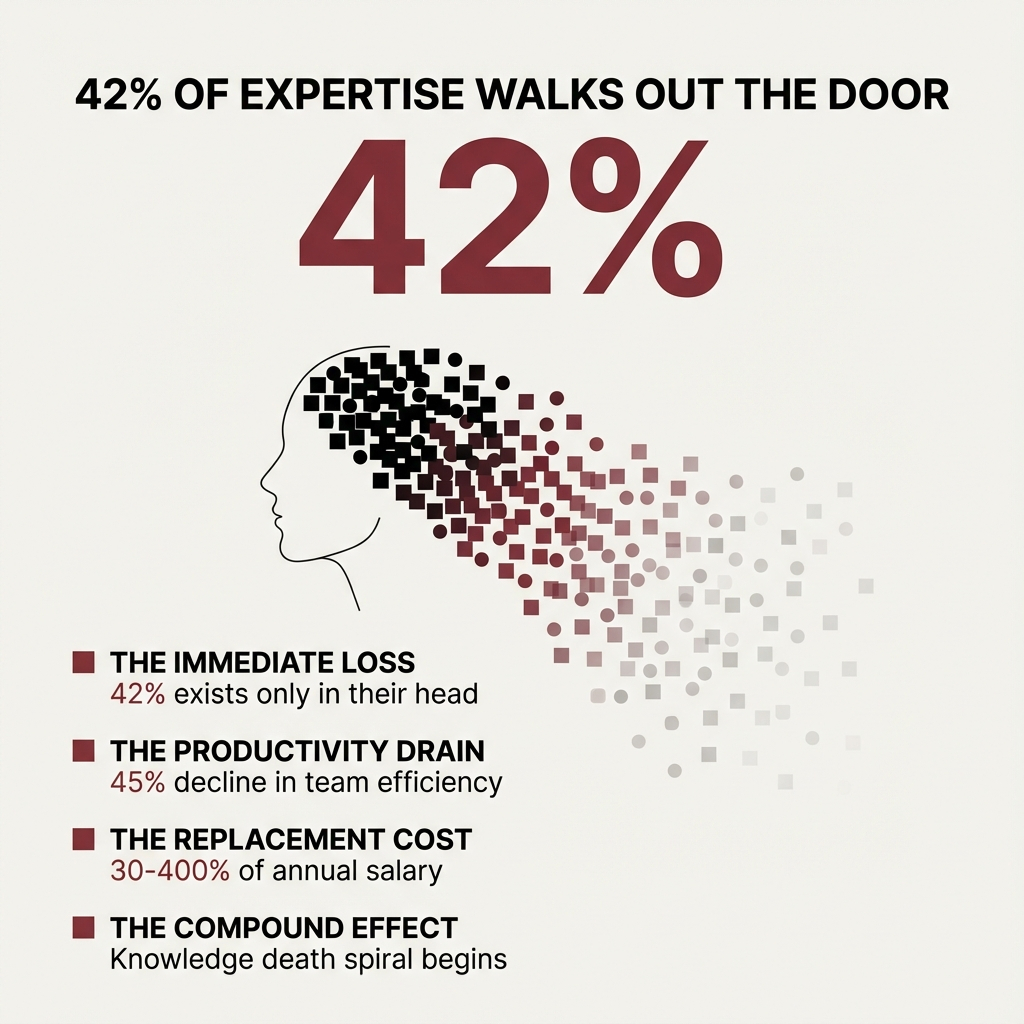
Here's what the data shows: 42% of what an employee knows about their role exists only in their head. When they leave, you lose nearly half of their functional expertise immediately.
The replacement cost ranges from 30% to 400% of their annual salary. But that number misses the deeper damage.
Seven in ten organizations reported that recent turnover made it difficult for current employees to find and access important information. The knowledge didn't just leave with the person—it created gaps that ripple across the entire operation.
45% of firms cited workplace inefficiency and declining productivity as the most significant challenge from knowledge loss. Your remaining team spends their time searching for information that used to be accessible, asking questions that used to have answers, and recreating work that was already done.
The productivity drain compounds. Mounting pressure on existing employees to recover a departing employee's knowledge triggers dissatisfaction, which triggers more turnover, which creates more disruption.
You end up in a knowledge death spiral.
Why Traditional Solutions Don't Work
Most firms respond with documentation requirements, knowledge transfer sessions, or wikis that nobody maintains.
These approaches fail because they treat knowledge as static content rather than dynamic infrastructure.
Documentation captures what people remember to write down. It doesn't capture the decision context, the relationship history, or the pattern recognition that develops over years of client work. If best practices exist only in employees' minds or scattered across systems, the chain of knowledge breaks irretrievably when people leave.
The gap becomes obvious during onboarding. 56% of organizations reported that knowledge loss made onboarding more difficult and less effective. New hires can't learn from what doesn't exist in accessible form.
Nearly half of firms believe this knowledge loss undermines their hiring efforts entirely. You're trying to attract talent to an organization that can't reliably transfer expertise.
What Organizational Consciousness Actually Means
I've spent three decades watching expertise evaporate through acquisitions, transitions, retirements, and organizational drift. The pattern is consistent: firms treat memory as disposable rather than infrastructure.
Organizational consciousness changes that equation.
It means building systems that capture not just what people know, but how they think. The decision frameworks. The client relationship dynamics. The lessons learned from projects that succeeded and ones that failed.
This isn't about replacing human expertise. It's about preserving what makes people irreplaceable even after they're gone.
The World Economic Forum predicts AI and automation will create 170 million new roles by 2030 while making 92 million existing jobs redundant. The workforce transformation is already underway. The firms that survive won't be the ones with the best retention programs—they'll be the ones that capture and deploy collective intelligence regardless of individual tenure.
The Resilience Advantage
In 2024, almost 80% of organizations experienced supply chain disruptions. Most faced between one and ten separate disruption events.
Resilience became a measurable business imperative, not just a concept.
The firms that maintained continuity had something in common: they didn't depend on specific individuals to hold critical knowledge. When disruption hit—whether from turnover, restructuring, or external shocks—they could maintain operational stability because their organizational memory was infrastructure, not tribal knowledge.
This advantage compounds over time. Creating a strategy for preserving institutional knowledge makes your business more resilient when employees move on, and it strengthens long-term innovation and growth.
The competitive differentiation isn't about having better people. It's about retaining what better people create, learn, and discover.
What This Looks Like in Practice
I incorporated Experio in July 2024. We made our first hire in August, raised pre-seed funding by fall, shipped an MVP in January, and launched our first pilot in May.
Speed with structure.
We built an AI operating system that captures organizational memory as infrastructure. When someone asks a question, the system doesn't just search documents—it understands context. It knows the project history, the client relationships, the decision patterns that led to previous outcomes.
The system remembers what organizations forget.
Firms using this approach report that new hires reach full productivity faster because they can access the collective intelligence of the entire organization. Senior people spend less time answering repeated questions because the answers exist in accessible, contextualized form.
Knowledge becomes reusable instead of disposable.
The Choice You're Making Right Now
Every day you operate without organizational memory infrastructure, you're making a choice.
You're choosing to accept that 42% of what each employee knows will vanish when they leave. You're choosing to spend 30-400% of salary replacing not just the person, but the expertise they carried. You're choosing to watch your remaining team waste 45% of their productivity searching for information that should be instantly accessible.
The firms that recognize this as a design failure rather than a cost of doing business will build different foundations.
They'll capture expertise as it develops, not after it's gone. They'll treat organizational memory as infrastructure that enables resilience, not nostalgia that slows change. They'll measure success by how effectively collective intelligence flows, not by how long individuals stay.
The workforce transformation is already here. The question isn't whether your people will change—it's whether your organizational memory will survive the change.
I'm building the infrastructure that makes that survival possible. The firms that adopt this approach now gain an advantage. The firms that wait face disruption they could have prevented.
What you do with that information is up to you.