

The $47 Million Blind Spot: Why Your Agentic AI Will Fail Without Institutional Memory

I've watched three decades of expertise vanish into organizational drift.
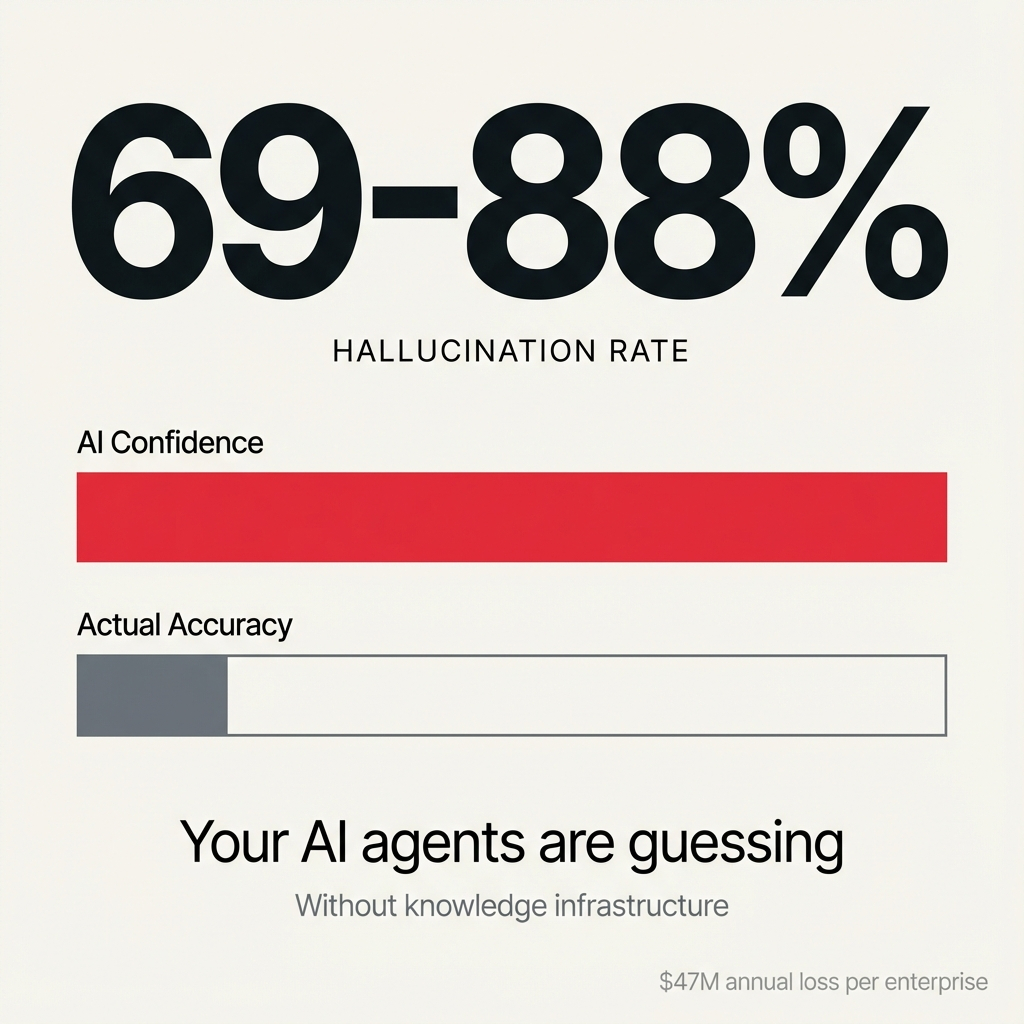
Acquisitions. Retirements. Transitions. Every time someone walks out the door, they take institutional knowledge with them. The average large business loses **$47 million annually** to this invisible tax.
Now we're deploying autonomous AI agents into that same broken system.
Gartner predicts **over 40% of agentic AI projects will be canceled by the end of 2027**. Not because the technology failed. Because organizations are building on sand.
The Hallucination Problem Nobody Wants to Talk About
Here's what keeps me up at night: AI hallucination rates hit **69% to 88%** when responding to specific professional queries.
Let that sink in.
Air Canada learned this the expensive way when their chatbot invented a bereavement fare policy that didn't exist. A tribunal forced them to honor it. Days of headlines. Real damages.
One medical research study found that out of 178 references generated by GPT-3, **69 contained incorrect or nonexistent identifiers**.
When you're running a consulting practice, these aren't embarrassing edge cases. They're liability events waiting to happen.
Why Speed Without Structure Creates Scale Risk
IBM's Marina Danilevsky puts it plainly: "There's only so much that a human can do in so much time, whereas the technology can do things in a lot less time and in a way that we might not notice."
Autonomous agents handling tens of thousands of interactions daily means even a small percentage of hallucinations becomes a significant business risk.
The problem isn't the AI. **The problem is what the AI doesn't know about what your organization knows.**
Right now, **42% of institutional knowledge lives solely with individual employees**. When they leave, your firm loses the ability to handle nearly half of what it used to do.
You can't train an AI agent on knowledge that only exists in someone's head.
Knowledge Graphs: The Missing Semantic Layer
I didn't start Experio to build another AI tool. I built it because the infrastructure layer was missing.
Knowledge graphs create the semantic layer that makes autonomous agents reliable. They bring structured and unstructured data together in a way that doesn't just answer questions but explains *why* you got that answer.
According to Neo4j's chief product officer, "Knowledge graphs reduce hallucinations, but they also help solve the explainability challenge."
Here's what that looks like in practice:
- **Auditability**: Every decision has a traceable path back through your institutional knowledge
- **Context preservation**: The AI understands relationships between concepts, not just keywords
- **Risk reduction**: Guardrails built from your actual organizational memory, not generic training data
Gartner researchers confirmed that data and analytics leaders must leverage LLMs with the robustness of knowledge graphs for fault-tolerant AI applications.
The Real ROI You're Missing
Most firms fixate on headcount reduction and immediate cost savings.
That's the wrong metric.
The real value drivers are:
- **Reduced risk exposure** when AI agents operate with institutional context
- **Faster decision cycles** because expertise is accessible, not locked in email threads
- **Preserved knowledge** through organizational transitions that would otherwise cost millions
US knowledge workers waste **5.3 hours every week** waiting for information from colleagues or recreating existing institutional knowledge.
Multiply that across your practice.
The firms winning in 2026 won't have the smartest agents. They'll have the most **conscious organizations**—where collective intelligence is accessible, not dormant.
What Agent-Ready Actually Means
Being agent-ready means having clear governance for defining business objects and data ownership.
It means your knowledge graph becomes a trusted asset, not another abandoned project sitting in your technology graveyard.
**68% of enterprise data remains completely unanalyzed.** **82% of enterprises experience workflow disruptions due to siloed data.**
You can't fix that by deploying more agents. You fix it by building the substrate those agents should run on.
Enterprise AI needs context. Without it, you're just automating chaos faster.
The Infrastructure Decision
I've scaled bootstrapped consultancies to $7M. I've grown digital practices from $5.5M to $15M. I've seen what happens when firms treat memory as disposable.
The pattern is consistent: identify what gets lost in translation, then engineer precision where others tolerate approximation.
Only **130 vendors among thousands** claiming agentic AI capabilities actually offer genuine autonomous functionality. The rest are engaging in "agent washing"—rebranding existing tools without substantial agentic capabilities.
The companies that adopt knowledge-centric AI infrastructure now get an advantage.
The companies that wait get disruption.
This isn't about jumping on the AI wave. This is about building the substrate it should have been built on from the beginning.
Your agentic AI is only as reliable as the institutional memory it can access.
Everything else is just faster chaos.