

The Three Layers of Organizational Memory Your Firm Is Losing Right Now

I've spent three decades watching expertise evaporate from consulting firms.
Not because people weren't smart. Not because the work wasn't valuable. But because we've treated organizational memory as something that takes care of itself.
It doesn't.
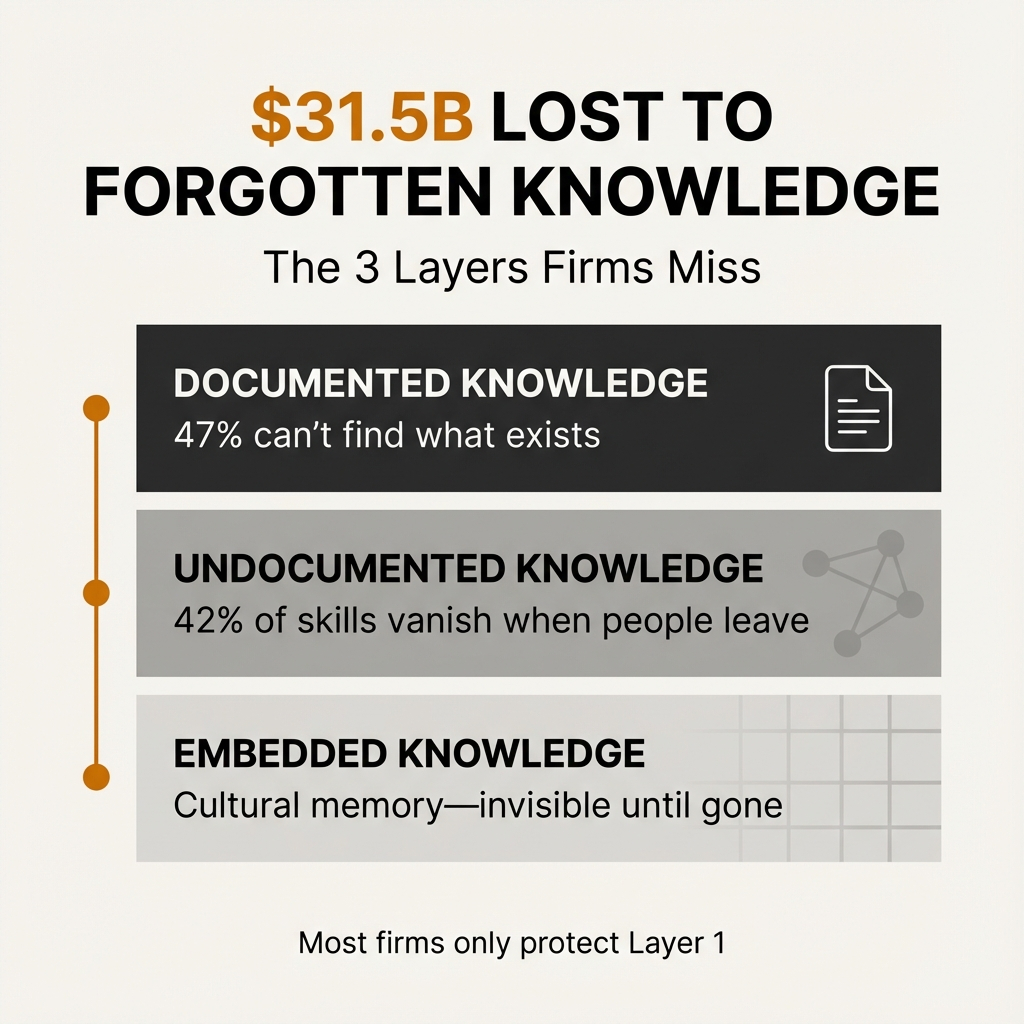
Fortune 500 companies lose approximately **$31.5 billion per year** due to forgotten organizational knowledge. A firm with 1,000 employees can expect to lose **$2.4 million annually** in productivity due to knowledge loss alone.
The problem isn't that we don't have the information. The problem is that we've never understood what organizational memory actually is.
Three Layers That Make Up Institutional Intelligence
Organizational memory exists in three distinct layers. Most firms only protect one of them.
Layer 1: Documented Knowledge
This is the visible layer. Your databases, archives, policies, procedures, case studies, and project documentation.
It's what gets stored in SharePoint folders that nobody opens. It's the 47-page methodology deck that took six months to create and gets referenced once a year.
This layer feels safe because it's tangible. You can point to it. You can back it up. You can organize it into taxonomies that make sense to exactly nobody.
But here's what most firms miss: **documented knowledge is only valuable if people can actually find and use it**.
Research shows that 47% of knowledge workers have trouble finding information relevant to their roles. Employees spend an average of **six hours every week** duplicating work that's already been done.
Documentation without retrieval is just organized hoarding.
Layer 2: Undocumented Knowledge
This is the invisible layer. The tacit insights that live in people's heads. The informal networks that actually get things done. The mentoring conversations that happen in hallways.
When your senior partner knows exactly which client stakeholder to call when a project stalls, that's undocumented knowledge.
When your practice lead can predict which proposals will win based on subtle signals in the RFP language, that's undocumented knowledge.
When your team knows the real decision-making process at a client organization versus the official one, that's undocumented knowledge.
And here's the brutal truth: **42% of the skills required to perform a role disappear when an employee leaves a company**.
The average job tenure has dropped from 9.2 years in the 1980s to 3.4 years in the 2020s. Over 90% of millennials don't plan to stay for more than three years in a job.
You're not just losing people. You're losing the collective intelligence they carried.
Layer 3: Embedded Knowledge
This is the cultural layer. The frameworks that shape how your firm thinks. The norms that guide how decisions get made. The shared language that makes communication efficient.
It's why some firms move fast while others get stuck in analysis paralysis. It's why certain teams collaborate naturally while others need three meetings to schedule a meeting.
Embedded knowledge is the hardest to see because it operates as organizational muscle memory. You don't think about it until it's gone.
NASA lost the knowledge and capacity to replicate how the first man was sent to the moon. Not because they lost the documentation. Because they lost the engineers who understood the tacit and embedded knowledge that made it work.
If NASA tried to get to the moon today, they would have to recreate and relearn most of the experience from scratch.
Why Traditional Knowledge Management Fails
Most knowledge management systems only address Layer 1.
They give you better search. They give you document repositories. They give you wikis that nobody updates.
But they don't capture the conversation where your principal explained why a certain client approach works. They don't preserve the network of relationships that makes cross-practice collaboration possible. They don't encode the cultural norms that determine which ideas get traction.
The average enterprise wastes **$2.5 to $3.5 million per year** due to ineffective knowledge systems. That's based on just 1,000 workers who search for nonexistent information, fail to find existing information, or recreate information that can't be found.
You can't solve a three-layer problem with a one-layer solution.
How AI-Powered Knowledge Graphs Change the Equation
Knowledge graphs organize data from multiple sources, capture information about entities, and forge connections between them.
But here's what makes them different: they don't just store information. They understand relationships.
When your team asks a question, a knowledge graph doesn't just search for keywords. It understands context. It knows who worked on similar projects. It connects documented procedures with the undocumented insights that make them actually work. It surfaces the embedded cultural knowledge that shapes how decisions should be made.
At Experio, we've built an AI operating system that captures all three layers.
**Layer 1** gets structured and made retrievable through semantic search that understands what you're actually asking for.
**Layer 2** gets preserved through continuous learning from how your team works, what questions they ask, and which solutions actually get used.
**Layer 3** gets encoded through pattern recognition that identifies the frameworks, norms, and decision-making models that define how your firm operates.
The result isn't just better search. It's organizational consciousness.
What Becomes Possible
When you capture all three layers of organizational memory, you stop losing expertise every time someone leaves.
Your new hires don't spend 200 hours trying to learn what your veterans already know.
Your teams don't waste 30% of billable time searching for information that should be instantly accessible.
Your firm doesn't repeat the same mistakes because the lessons learned actually get retained and applied.
Knowledge becomes infrastructure instead of institutional folklore.
I'm not building this because AI is trendy. I'm building it because I've watched too many firms lose what made them valuable.
The firms that figure this out early get an advantage. The ones that wait get disruption.
Your organizational memory is either an asset you leverage or a liability you're ignoring.
The choice is structural, not technological.