

When Memory Meets Consciousness: What Actually Happens Inside Consulting Firms
I've spent three decades watching consulting firms lose the same knowledge over and over.
A senior partner retires. A practice leader moves to a competitor. A merger shuffles the org chart. And every time, the same thing happens: **expertise evaporates**.
The firm doesn't just lose a person. It loses the accumulated judgment, the client history, the lessons learned from failed proposals, the shortcuts that actually work. All of it vanishes because we've treated organizational memory as something that lives in people's heads instead of something we can build infrastructure around.
But here's what I've learned from deploying Experio across multiple consulting environments: memory alone isn't enough.
You need consciousness too.
The Difference Between Remembering and Knowing
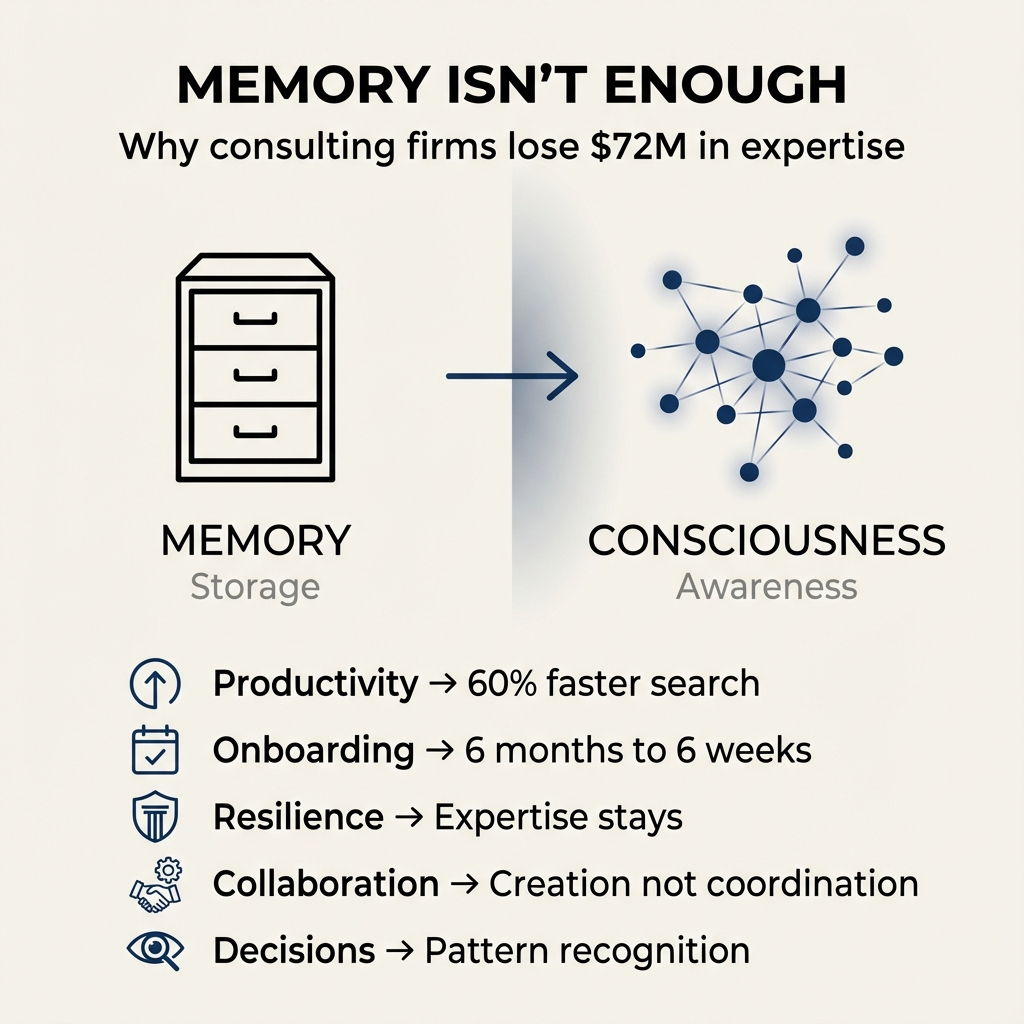
**Memory is storage. Consciousness is awareness.**
Most knowledge management systems give you memory. They capture documents, store emails, archive project files. You can search for things. You can retrieve information. That's valuable.
But consciousness is what happens when that memory becomes **collectively accessible and contextually aware**.
It's the difference between having a filing cabinet full of case studies and having a system that knows which case study matters for the proposal you're writing right now. It's the difference between storing best practices and surfacing the exact practice that applies to your client's specific situation.
When memory meets consciousness, organizations stop repeating themselves and start learning.
Five Things That Change When You Build Both
I've tracked the impact across our pilot deployments. The patterns are consistent.
1. Productivity Stops Leaking
McKinsey found that employees spend **1.8 hours every day searching for information**. That's 9.3 hours per week. You're paying five people but only four are working. The fifth is hunting for answers.
One of our clients cut that search time by 60% in the first quarter. Not because they hired more people or reorganized their SharePoint. Because the system learned what people needed and brought it to them in context.
The ROI showed up in billable hours. Partners stopped asking associates to "find that deck we did for the healthcare client in 2021." The system already knew which deck, which client, and which sections were relevant.
2. Onboarding Becomes Transfer, Not Training
**56% of managers report that knowledge loss makes onboarding more difficult.** I've seen firms spend six months getting a new hire to baseline competency because there's no structured way to transfer what the previous person knew.
With organizational consciousness, new team members access the collective intelligence from day one. They see how similar projects were scoped. They understand why certain approaches failed. They learn the firm's actual methodology, not just the one in the handbook.
One practice leader told me their time-to-productivity dropped from six months to six weeks. The knowledge was already there. They just made it accessible.
3. Resilience Becomes Structural, Not Personal
Losing a single employee can cost up to **213% of their salary** because it takes two years to replace their expertise. In consulting, where an average of 42% of what someone knows is unique to them, that loss compounds.
But when you build consciousness into your organization, departure doesn't equal disruption. The system retains what that person contributed. Their insights, their client relationships, their problem-solving patterns—all of it stays accessible.
I watched a firm lose three senior consultants in one quarter. Normally that would trigger chaos. Instead, their teams kept executing because the organizational memory didn't leave with the people.
4. Collaboration Shifts From Coordination to Creation
**Over 60% of employees say collaboration is critical for productivity and motivation.** But most collaboration tools focus on communication, not collective intelligence.
When you combine memory with consciousness, collaboration becomes about building on what already exists instead of starting from scratch. Teams stop duplicating work. They stop asking questions that were answered six months ago. They stop recreating frameworks that already exist.
The energy shifts from "let me catch you up" to "here's what we're adding." That's when innovation actually happens.
5. Decisions Get Smarter Because Context Gets Richer
Douglas Engelbart predicted in 1962 that augmenting collective intelligence would create a **multiplier effect in problem-solving**. Three people working with shared consciousness would be more than three times as effective as one person working alone.
I've seen this play out in real time. When decision-makers have access to the full organizational memory—not just what they personally remember or what someone happens to forward them—the quality of decisions changes.
They see patterns across clients. They recognize risks from previous engagements. They make connections between practice areas that seemed unrelated.
One client told me they caught a major scope gap in a proposal because the system surfaced a similar project from a different division. That single catch saved them from a six-figure overrun.
What This Actually Looks Like
Here's a real scenario from one of our deployments:
A mid-level consultant is preparing a digital transformation proposal for a manufacturing client. In a traditional setup, they'd search the shared drive, ask around, maybe find a few relevant examples.
With organizational consciousness, the system recognizes the context. It surfaces the three most relevant past proposals, highlights the sections that worked, flags the approaches that failed, and connects them to the specific challenges this manufacturing client mentioned in the intake call.
It doesn't just remember. It **knows**.
The consultant isn't starting from zero. They're building on the firm's collective expertise. The proposal is stronger. The client is more confident. The win rate goes up.
That's the multiplier effect.
The Infrastructure Decision
Most firms still treat knowledge management as a nice-to-have. A SharePoint site. A Slack channel. A quarterly knowledge-sharing session.
But when you recognize that **organizational memory loss costs an average of $72 million annually** for a 30,000-person company, the calculation changes.
This isn't about productivity hacks. It's about whether your firm learns or just repeats.
Memory gives you the foundation. Consciousness brings it to life. Together, they create something that doesn't exist in most consulting firms: **institutional intelligence that compounds instead of evaporates**.
I've built this because I spent three decades watching firms lose what made them valuable. The technology finally exists to fix it. The question is whether you'll build the infrastructure before your best people—and everything they know—walk out the door.
The firms that recognize this early get an advantage. The ones that wait get disruption.
You're deciding which one you'll be.