

Why 80% of AI Projects Fail (And What Knowledge Graphs Actually Fix)

I've watched dozens of consulting firms pour millions into AI initiatives that collapse within months.
The pattern is consistent. Excitement at launch. Promising demos. Then silence.
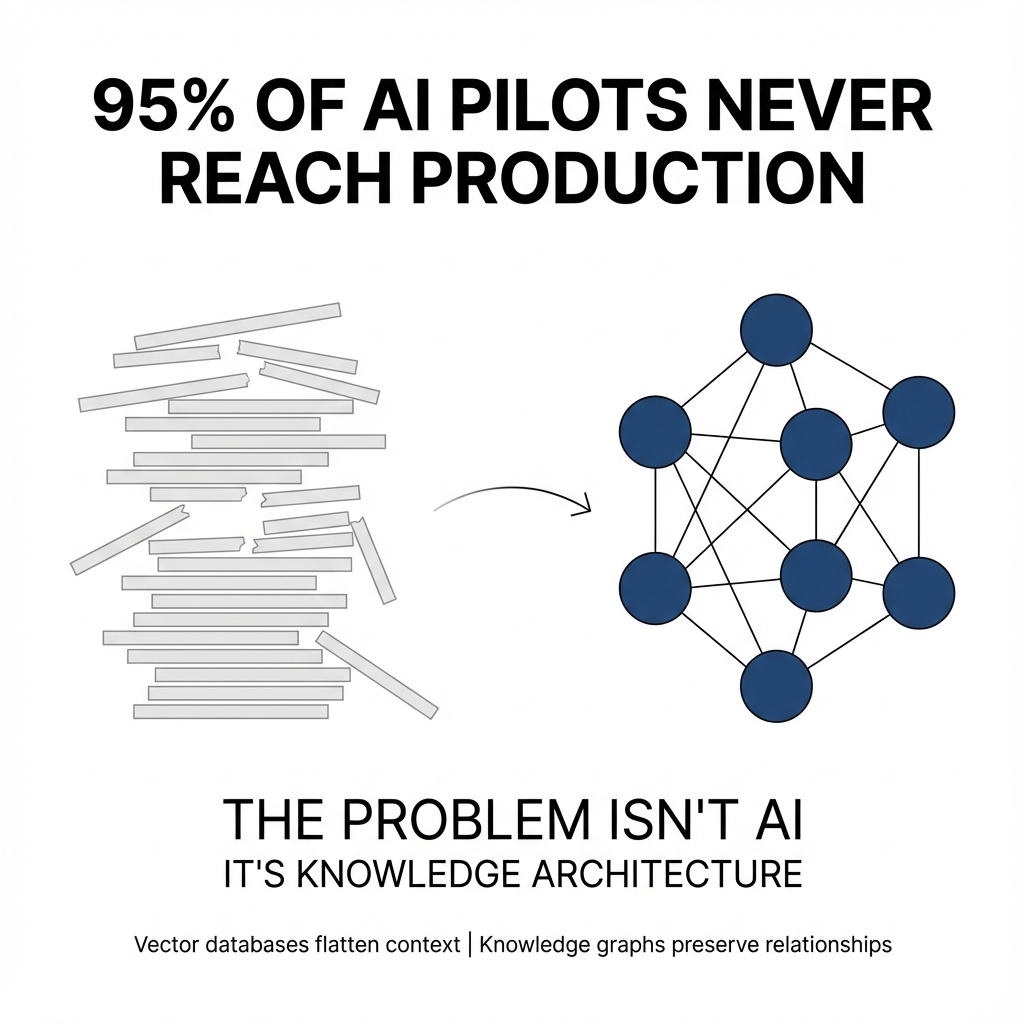
Between 70-85% of GenAI deployments fail to meet their ROI targets. That's twice the failure rate of regular IT projects. MIT's recent analysis of 150 companies found that 95% of generative AI pilots stall before reaching production.
The problem isn't the AI.
The Architecture Problem Nobody Talks About
Most firms treat AI implementation like a software upgrade. Install the tool, point it at your documents, watch productivity soar.
But AI doesn't fail because the models are weak. It fails because the knowledge infrastructure underneath can't support what the AI needs to do.
Gartner found that 39% of organizations cite "lack of data" as their top AI barrier. But they don't lack data. They lack AI-ready data. The global CDO survey confirms it: 43% struggle with data quality and readiness, 43% with technical maturity.
Your firm has decades of expertise scattered across SharePoint folders, email threads, project retrospectives, and the minds of people who might retire next year. That's not a knowledge base. That's knowledge chaos.
Why Vector Databases Create the Illusion of Progress
Most AI implementations use vector databases for retrieval. You ask a question, the system converts it to numbers, searches for similar numbers, and returns matching documents.
It works beautifully in demos.
It breaks in production.
Vector databases flatten context into embedding space. They lose the explicit structure that makes knowledge useful. When your consultant asks about a client's regulatory history, the system can't distinguish between what happened in 2019 versus what's happening now. It can't connect the client's industry challenges to your firm's specialized practice areas. It can't trace why a particular recommendation worked for similar engagements.
Context loss is the silent killer of AI adoption. You get answers that are technically relevant but operationally useless.
Knowledge Graphs: Structure as Strategy
Knowledge graphs introduce a different paradigm. Instead of treating knowledge as documents to search, they model it as a network of relationships.
Every entity—client, project, person, methodology, outcome—becomes a node. Every connection between them becomes a relationship. Time stamps preserve when things happened. Attributes capture why they matter.
When someone asks about client risk factors, the system doesn't just retrieve documents mentioning "risk." It traverses the graph: this client, in this industry, with this regulatory environment, similar to these past engagements, where these factors mattered, and these approaches worked.
The answer isn't found. It's constructed.
This is why knowledge graphs enable transparency that vector databases can't match. When the AI makes a recommendation, you can trace exactly which nodes and relationships informed it. If something's wrong, you fix the graph, not the model.
The Temporal Layer Most Firms Miss
Traditional knowledge graphs capture relationships. Temporal knowledge graphs capture how relationships evolve.
Your client's priorities shifted after the merger. Your practice area's methodology changed when new regulations passed. The consultant who led that engagement moved to a different division.
Static systems treat all knowledge as equally current. Temporal graphs understand that context has a timeline.
This matters when AI agents need to make decisions. They're not just retrieving information. They're integrating user interactions, enterprise data, and external knowledge into a coherent understanding that updates continuously.
McKinsey's "Lilli" assistant processes 100 years of institutional knowledge. Over 70% of their 45,000 employees use it, averaging 17 queries per week. They moved from weeks of manual searching to minutes of structured retrieval.
The difference isn't better search. It's better architecture.
What This Means for Your Firm
You have two paths.
Continue treating AI as a productivity tool layered on top of document chaos. Watch adoption stall when people realize the answers aren't reliable enough to trust.
Or recognize that organizational memory is infrastructure, not a feature.
Knowledge graphs aren't a technology choice. They're an architectural decision about how your firm thinks. They determine whether AI amplifies your expertise or just generates faster noise.
The firms that understand this now are building the substrate everyone else will need later. The ones that wait are optimizing for a paradigm that's already obsolete.
I'm not building this because knowledge graphs are trendy. I'm building it because 30 years of watching expertise evaporate taught me that memory loss is a design problem with an engineering solution.
The question isn't whether your firm needs this architecture.
The question is whether you'll build it before your competitors do.