

Why Your $2 Million Knowledge Management System Is Gathering Dust
I've watched consulting firms spend millions on knowledge management systems that never get used.
The pattern is consistent. Leadership approves the budget. IT implements the platform. Training sessions happen. Then, six months later, the system becomes a digital graveyard—filled with outdated documents that nobody searches and templates that nobody applies.
The failure rate isn't small. Knowledge management projects fail 50% to 70% of the time. Fortune 500 companies alone forfeit $31.5 billion annually because they can't share what they already know.
But here's what I've realized after three decades in this industry: the problem isn't the technology.
The Real Problem Nobody Talks About
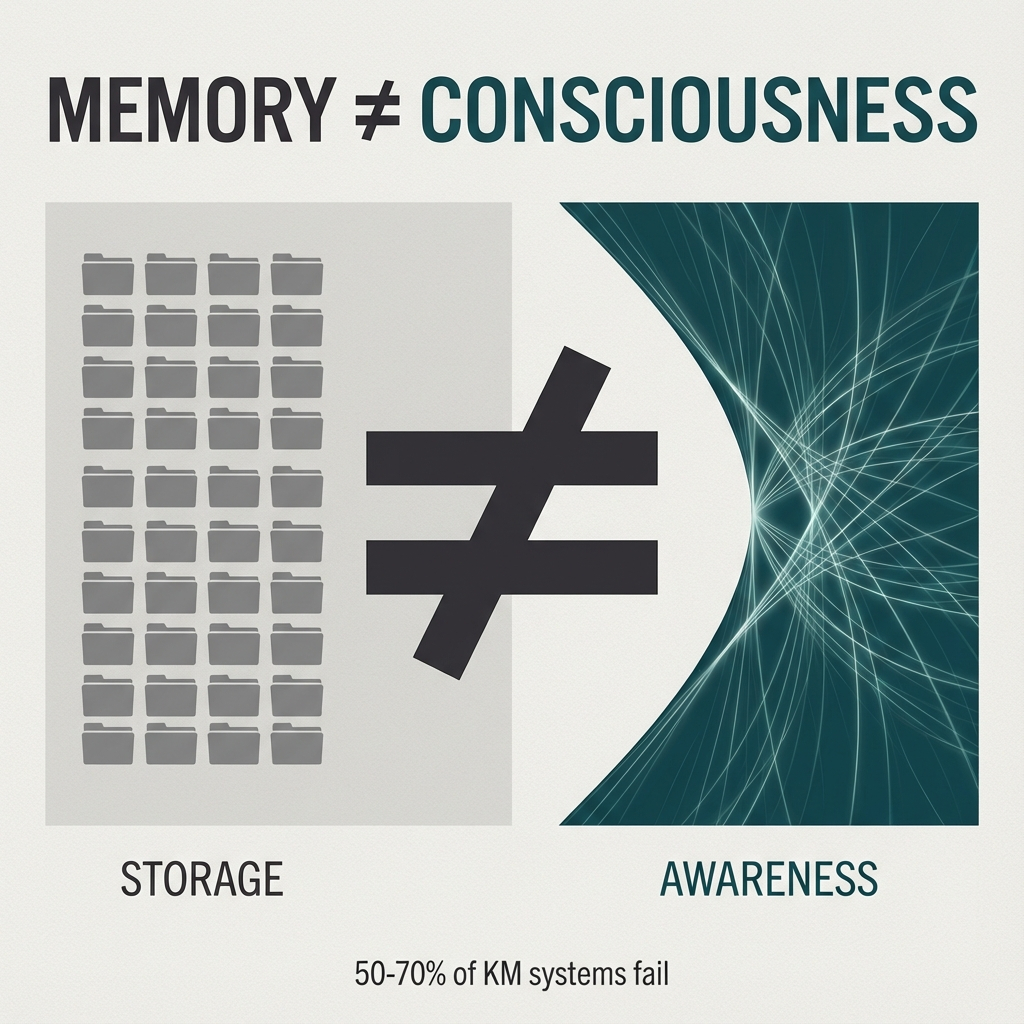
Most firms confuse organizational memory with organizational consciousness.
Organizational memory is what you've accumulated—every document, every presentation, every lesson learned from past engagements. It's your storage capacity.
Organizational consciousness is your collective awareness of what you know. It's your ability to access the right knowledge at the right moment and apply it with precision.
You can have perfect memory and zero consciousness. That's exactly what's happening when your senior consultant recreates an analysis that three other people already completed last quarter.
The Symptoms Are Everywhere
Your people spend 47% of their time—nearly half their workday—searching for information that already exists somewhere in your systems.
McKinsey estimates employees lose eight hours every week hunting for documents across platforms. That's 20% of billable time vanishing into search boxes and Slack threads.
When someone leaves your firm, you lose more than their productivity. You lose an average of 42% of the expertise they performed in their role—knowledge that exists nowhere else. One organization calculated that 700 retirees represented 27,000 years of collective experience walking out the door.
The cost of replacing that single employee? Up to 213% of their salary, because it takes two years to get someone to equivalent efficiency.
Why Traditional Solutions Don't Work
Knowledge management systems treat memory as a storage problem. Upload documents. Tag them properly. Build a search function. Done.
But consciousness doesn't work that way.
Your brain doesn't store memories in folders. It creates connections. It recognizes patterns. It surfaces relevant information based on context, not keywords.
When you ask your best consultant how they knew which approach to use on a complex engagement, they don't say "I searched our SharePoint." They say "I remembered a similar situation from three years ago."
That's consciousness. That's the capability your systems can't replicate.
The Gap Is Getting Worse
Average job tenure dropped from 9.2 years in the 1980s to 3.4 years today. Over 90% of millennials plan to leave within three years. Gen Z averages 2.3 years per role.
Your knowledge turnover is accelerating while your ability to capture and transfer that knowledge remains stuck in the SharePoint era.
Meanwhile, 67% of IT leaders report concern about knowledge loss from departures. 71% agree the Great Resignation contributed to organizational knowledge erosion.
The awareness exists. The solutions don't.
What Organizational Consciousness Actually Requires
Building consciousness means engineering systems that don't just store information—they understand context.
When a consultant asks "How did we handle the regulatory complexity on the financial services engagement last year?" the system needs to know:
- Which engagement they're referencing
- Who worked on it and what they learned
- What approach succeeded and what failed
- How that context applies to the current situation
- Who can provide additional insight if needed
That's not search. That's retrieval with comprehension.
The firms that figure this out don't just reduce search time by 30-35%. They fundamentally change how knowledge compounds over time. Every engagement builds on the last one. Every lesson learned becomes instantly accessible. Every new hire inherits decades of institutional wisdom from day one.
The Inflection Point
You're at a decision point.
You can keep investing in memory—better storage, smarter tags, more training on systems nobody wants to use. Or you can start building consciousness—systems that actually understand what your organization knows and make that knowledge accessible when it matters.
The firms that choose consciousness will compound their expertise. The firms that stick with memory will keep losing what makes them valuable.
The gap between those two futures is widening faster than most leaders realize.